Have you ever watched a pendulum swing back and forth, seemingly with a mind of its own, and wondered whether it was responding to something beyond the physical? Pendulum divination is one of the oldest and most accessible forms of intuitive practice, yet it remains wrapped in mystery for many people. Whether you are just beginning your spiritual journey or looking to expand your existing toolkit of energy-reading techniques, learning how to use a pendulum can open doors to self-discovery, clarity, and deeper connection with your inner wisdom.
In this comprehensive guide, we will explore everything you need to know about using pendulums for divination and energy reading. From selecting the right pendulum to understanding its movements, asking effective questions, and integrating pendulum work into your daily spiritual practice, this article will give you the foundation to develop a meaningful and reliable pendulum practice.
What Is a Pendulum and How Does It Work?
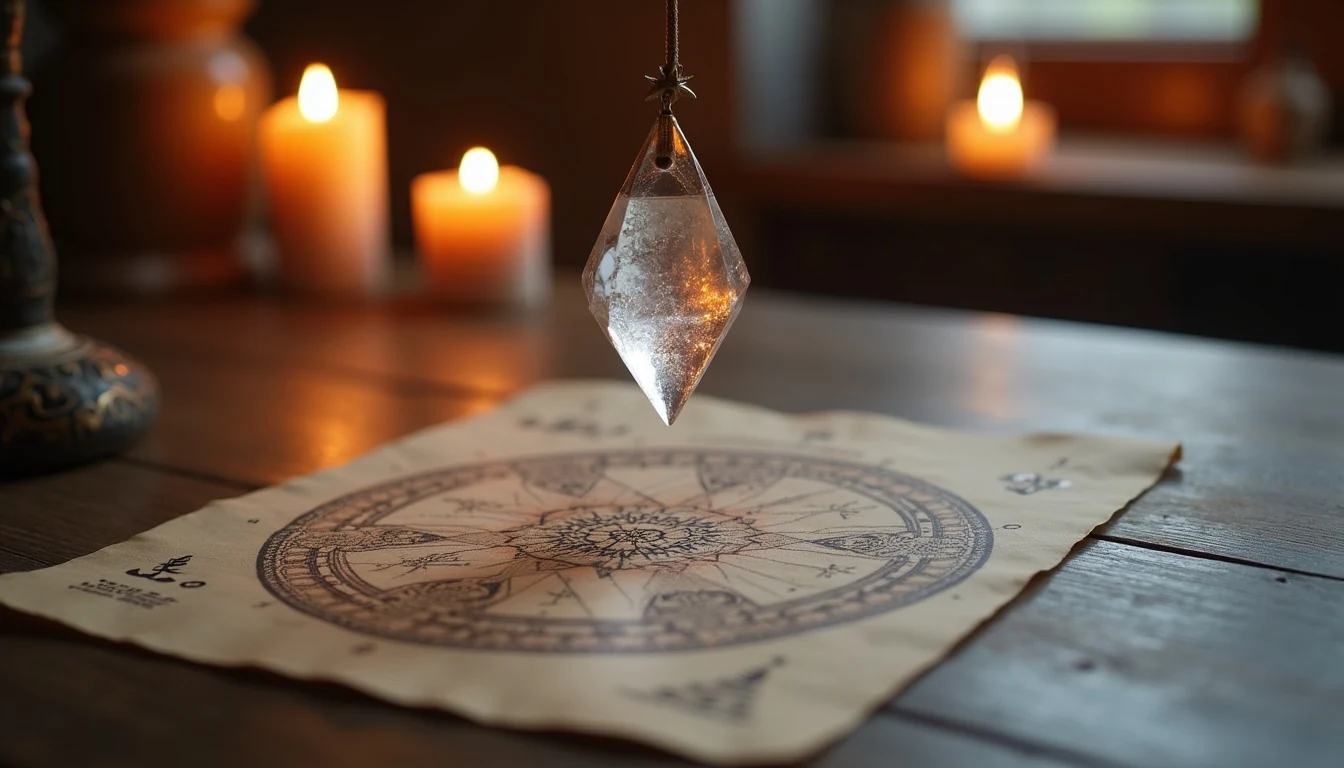
A pendulum, in the context of divination and energy work, is a weighted object suspended from a chain, string, or cord. The weight—often called the bob—can be made from a wide variety of materials including crystal, metal, wood, or even glass. When held between the thumb and forefinger, the pendulum is free to swing in any direction, and practitioners interpret these movements as responses to questions or as indicators of energy flow.
The mechanism behind pendulum movement has been debated for centuries. Skeptics attribute the motion to the ideomotor effect—unconscious micro-movements made by the person holding the pendulum. Practitioners, however, understand that these micro-movements are precisely the point. The pendulum acts as an amplifier for your subconscious and intuitive signals, making subtle internal responses visible and tangible. Whether you view it as a tool that taps into universal energy, your higher self, or simply your own deep knowing, the pendulum serves as a bridge between the conscious mind and information that lies below the surface of ordinary awareness.
The Historical Roots of Pendulum Divination
Pendulum divination, also known as dowsing or radiesthesia, has roots that stretch back thousands of years. Ancient Egyptians used pendulum-like devices in their temples. Chinese emperors employed dowsing techniques to locate water and minerals. During the Middle Ages in Europe, dowsing was widely practiced despite occasional condemnation by religious authorities. In more recent history, pendulums were used during World War I and II by military personnel to locate mines and underground structures.
The enduring presence of pendulum work across cultures and centuries speaks to something fundamental about human nature—our desire to access knowledge beyond what the rational mind alone can provide. Today, pendulum divination is experiencing a resurgence as more people seek holistic and intuitive approaches to wellness, decision-making, and spiritual growth.
Choosing the Right Pendulum for You
Selecting a pendulum is a personal process, and there is no single “best” choice. Different materials carry different energetic properties, and the right pendulum for you is the one that feels natural and responsive in your hand. Here are the most common types and their characteristics:
Crystal Pendulums
Crystal pendulums are among the most popular choices for divination work. Clear quartz is especially favored because it is considered a universal amplifier—it enhances whatever intention or energy you bring to your practice. Amethyst pendulums are associated with spiritual insight and third-eye activation, making them excellent for meditation and intuitive work. Rose quartz pendulums carry a gentle, heart-centered energy that supports questions about relationships, self-love, and emotional healing. Black tourmaline or obsidian pendulums offer protective qualities and are ideal for energy clearing and boundary-setting practices.
Metal Pendulums
Brass, copper, and silver pendulums are valued for their conductivity. Metal pendulums tend to respond quickly and decisively, which some practitioners find helpful when seeking clear yes-or-no answers. Brass is associated with solar energy and clarity, copper with healing and energy flow, and silver with lunar energy and intuition. If you prefer crisp, unambiguous responses, a metal pendulum might be the right fit.
Wooden Pendulums
Wooden pendulums carry the grounding energy of the trees from which they are made. They tend to produce slower, more deliberate movements, which some practitioners find easier to read. Wooden pendulums are also less likely to pick up stray electromagnetic interference, making them a good choice for those who work in environments with a lot of electronic equipment.
How to Test a Pendulum Before Buying
When choosing a pendulum, hold it in your dominant hand and let it hang freely. Ask it a simple question with a known answer, such as “Is my name [your name]?” Notice how it responds. Does it move clearly? Does the movement feel right to you? Trust your instincts—if a pendulum feels warm, tingly, or simply “right” in your hand, it is likely a good match. If it feels cold, heavy, or unresponsive, try a different one.
Preparing Yourself and Your Space for Pendulum Work
Before you begin working with a pendulum, it is important to create the right conditions—both internally and externally. Pendulum divination relies on your energetic state, and factors like stress, distraction, and environmental noise can all affect the clarity of your readings.
Grounding and Centering
Start each pendulum session with a brief grounding exercise. Sit with your feet flat on the floor, close your eyes, and take several slow, deep breaths. Visualize roots extending from the soles of your feet deep into the earth, anchoring you firmly. Feel your body settle into your chair and notice the weight of your hands resting in your lap. This grounding process helps quiet mental chatter and establishes a clear channel for intuitive information.
Centering is the next step. Bring your awareness to the center of your chest—your heart space. Imagine a warm light glowing there, steady and calm. When you feel centered, you are less likely to be influenced by anxiety, wishful thinking, or outside energies, all of which can distort pendulum readings.
Cleansing Your Pendulum
Pendulums, like any spiritual tool, can absorb energy over time. Cleansing your pendulum regularly ensures that it remains clear and responsive. There are several effective methods for cleansing:
Smoke cleansing: Pass your pendulum through the smoke of burning sage, palo santo, or cedar. This is one of the most traditional and widely used methods.
Moonlight: Place your pendulum in direct moonlight overnight, ideally during the full moon. The gentle, purifying energy of moonlight is especially suitable for crystal pendulums.
Sound: Use a singing bowl, tuning fork, or bell near your pendulum. The vibrations break up stagnant energy and restore clarity.
Visualization: Hold your pendulum and visualize white light flowing through it, washing away any residual energy. This method is quick and can be done anywhere.
Setting Up Your Space
Choose a quiet space where you will not be interrupted. Dim the lighting if possible, and consider lighting a candle to create a focused, meditative atmosphere. Some practitioners like to place their pendulum on a cloth—black velvet is traditional—to reduce visual distraction and create a defined energetic boundary. Make sure your phone is silenced and that you are in a comfortable, upright position.
How to Program Your Pendulum
Programming your pendulum means establishing a clear system of communication between you and the tool. This is one of the most critical steps in pendulum work, and skipping it is the most common reason beginners get confusing or inconsistent results.
Establishing Your Yes, No, and Maybe Responses
Hold your pendulum by the top of the chain, letting the bob hang freely about an inch above a flat surface. Keep your arm steady and relaxed—your elbow should be supported. Now ask the pendulum to show you its “yes” response. You might say, “Show me yes.” Watch the pendulum’s movement carefully. It may swing back and forth, side to side, in a circle clockwise, or in a circle counterclockwise.
Once you have identified the “yes” movement, ask the pendulum to show you “no.” Then ask it to show you “maybe” or “I don’t know.” Write down these movements so you remember them. Every person’s pendulum may respond differently—there is no universal standard. What matters is that you and your pendulum have a consistent, agreed-upon language.
Verifying Your Signals
After programming, test the signals with questions that have known answers. Ask, “Is the sky blue?” and confirm that you get a “yes.” Ask, “Is the sky green?” and confirm a “no.” If the responses are consistent, your programming is solid. If not, repeat the programming process. Sometimes it takes a few sessions before the communication becomes reliable, so be patient with yourself and your pendulum.
Asking Effective Questions for Accurate Readings
The quality of your pendulum readings depends heavily on the quality of your questions. Vague, ambiguous, or emotionally charged questions tend to produce unclear or misleading responses. Here are guidelines for crafting effective pendulum questions:
Be Specific and Clear
Instead of asking, “Will I be happy?” ask, “Will taking this new job bring me greater fulfillment in the next six months?” The more specific your question, the clearer the response. Pendulums respond to precision, not vagueness.
Ask One Question at a Time
Compound questions confuse the pendulum. “Should I move to a new city and start a new career?” is really two questions. Break it down: “Should I move to a new city?” Then, “Should I start a new career?” This approach yields more accurate and useful answers.
Frame Questions in a Neutral Tone
Your emotional state influences pendulum movement. If you desperately want a “yes,” your unconscious movements may produce one regardless of the actual answer. To counter this, frame questions as neutrally as possible. Instead of “Is this the most amazing opportunity ever?” try “Is this opportunity aligned with my highest good right now?”
Avoid Questions About Other People
Pendulum work is most reliable when it concerns your own energy and decisions. Asking about another person’s thoughts, feelings, or future without their consent raises ethical concerns and tends to produce unreliable results. Focus on what you can control—your own choices, energy, and path.
Pendulum Divination Techniques
Once you have programmed your pendulum and practiced asking clear questions, you can explore several different divination techniques. Each method has its own strengths, and you may find that you prefer some over others.
Simple Yes/No Divination
This is the most straightforward and commonly used technique. Hold your pendulum, ask a clear yes-or-no question, and observe the movement. This method is ideal for daily guidance, quick decision-making, and checking in with your intuition throughout the day. Over time, you will develop confidence in your ability to distinguish genuine intuitive signals from wishful thinking.
Pendulum Charts and Boards
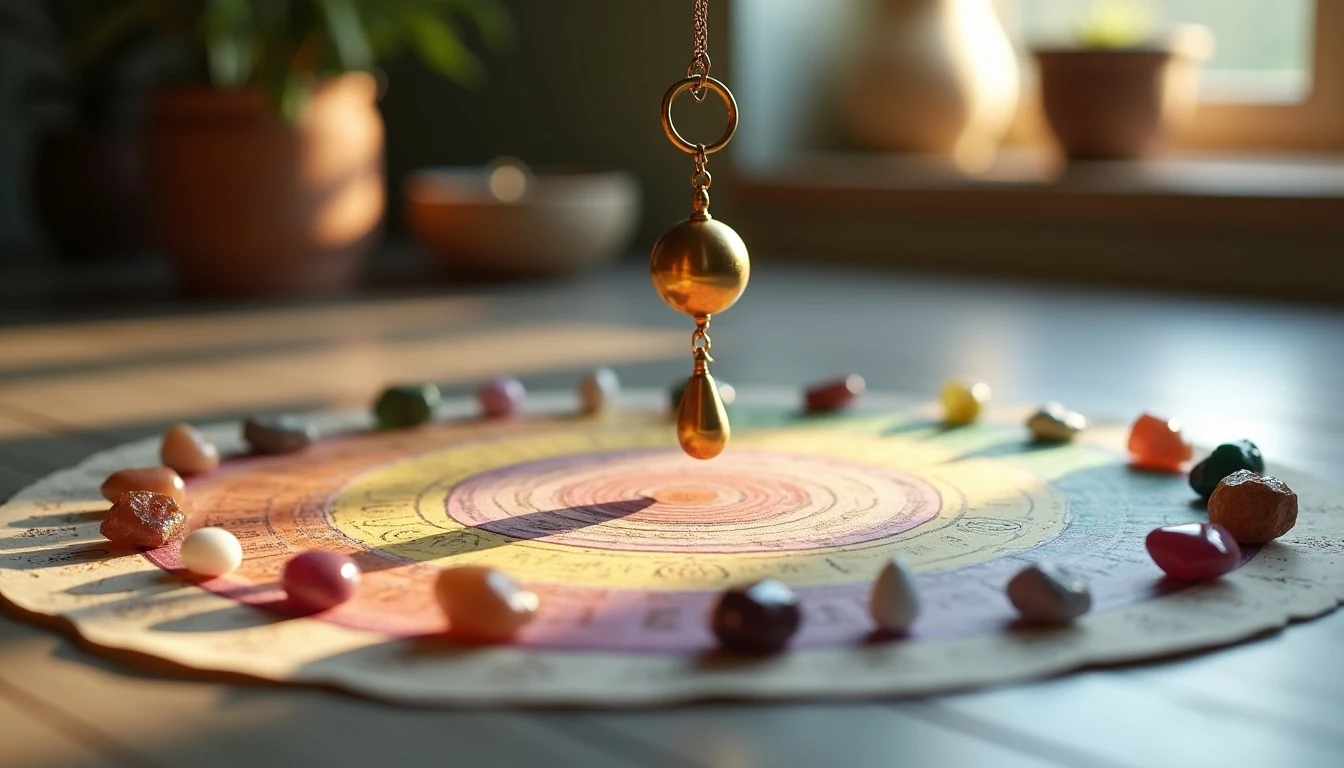
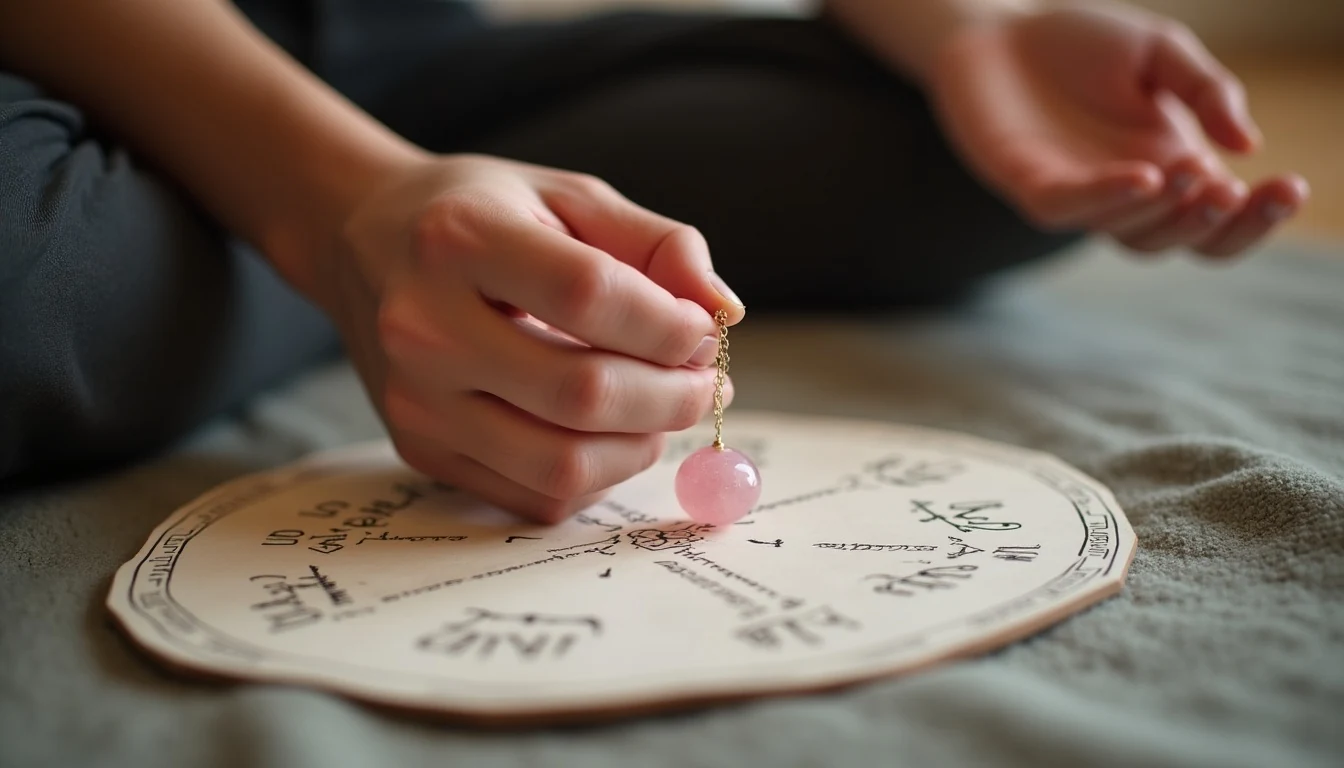
For more complex questions, pendulum charts can provide richer information than simple yes/no responses. A pendulum chart is a printed or drawn diagram with multiple possible answers arranged in a circle or semicircle. Common chart types include:
Percentage charts: Numbers from 0 to 100 arranged in a semicircle. Ask “How aligned is this decision with my highest good?” and the pendulum will swing toward a specific number.
Letter and number charts: Useful for spelling out words or receiving numerical information.
Chakra charts: Designed to show which chakras are balanced, overactive, or underactive. The pendulum swings toward the relevant chakra on the diagram.
Custom charts: You can create your own charts tailored to any specific area of inquiry, such as career options, health concerns, or relationship dynamics.
When using a chart, hold the pendulum directly over the center of the diagram and ask your question clearly. Allow the pendulum to swing naturally toward the relevant section of the chart.
Map Dowsing
Map dowsing is a technique for using a pendulum over a map to locate objects, energy lines, or places of significance. Hold the pendulum over a map and ask it to indicate the location of whatever you are seeking. The pendulum may swing in a circle or pull in a particular direction when it passes over the relevant area. This technique requires practice and is best attempted after you have developed confidence with basic yes/no divination.
Pendulum Energy Reading Techniques
Beyond question-and-answer divination, pendulums are powerful tools for reading energy. Energy reading involves using the pendulum to assess the flow, quality, and balance of energy in yourself, other people, spaces, or objects.
Chakra Assessment
One of the most popular energy-reading applications is chakra assessment. To read your own chakras, lie down comfortably and hold the pendulum a few inches above each chakra point, starting at the root and moving upward. Allow the pendulum to move naturally and observe the pattern:
Clockwise circle: The chakra is open and balanced.
Counterclockwise circle: The chakra is clearing or releasing energy.
Side-to-side swing: The chakra is partially blocked or imbalanced.
Elliptical or irregular movement: The chakra is in transition or experiencing conflict.
No movement: The chakra may be significantly blocked.
Keep a journal of your chakra readings over time. This creates a valuable record of your energetic patterns and helps you identify recurring imbalances that may need attention through meditation, crystal work, affirmations, or other healing practices.
Aura Scanning
You can also use a pendulum to scan the aura—the energetic field that surrounds the body. Hold the pendulum about six inches from the body and slowly move it along the outline of the person’s form. Notice where the pendulum speeds up, slows down, changes direction, or stops. These variations indicate areas of strong energy, blockages, or energy leaks in the aura.
Aura scanning is particularly useful before and after energy healing sessions. By comparing readings before and after a Reiki session, crystal healing, or meditation, you can observe the effects of the healing work and identify areas that may need additional attention.
Space and Object Reading
Pendulums can also be used to assess the energy of spaces and objects. To read a space, walk through it slowly while holding the pendulum. Notice where the pendulum moves more actively or less actively. Areas of heavy, sluggish energy may benefit from cleansing with sage, sound, or fresh air. Areas of light, active energy are typically supportive and nourishing.
To read an object, hold the pendulum over it and observe the movement. Crystals, jewelry, and gifts often carry the energy of their previous owners or the circumstances in which they were created. If the pendulum moves erratically or feels heavy over an object, it may need cleansing before you use it.
Common Mistakes and How to Avoid Them
Even experienced pendulum practitioners can fall into patterns that compromise the accuracy of their readings. Being aware of these common pitfalls will help you maintain the integrity of your practice.
Leading the Pendulum
This is the most common mistake, especially among beginners. When you want a particular answer, you may unconsciously move your hand to produce that response. To avoid leading, keep your arm relaxed, your breathing steady, and your mind as neutral as possible. If you catch yourself anticipating a specific answer, pause, take a breath, and recenter before continuing.
Asking When Emotionally Overwhelmed
Strong emotions—whether fear, excitement, grief, or anger—can distort pendulum readings significantly. If you are in a heightened emotional state, wait until you have calmed down before working with your pendulum. Use grounding techniques, take a walk, or meditate first. The pendulum reflects your internal state, so clarity within leads to clarity without.
Overusing the Pendulum
Some people become so dependent on their pendulum that they consult it for every minor decision. This weakens your own intuitive muscles and can lead to confusion rather than clarity. Use the pendulum as a supplement to your own inner knowing, not a replacement for it. A good practice is to first check in with yourself—what does your gut tell you?—and then use the pendulum to confirm or explore further.
Not Cleansing Regularly
Pendulums that are not cleansed regularly can accumulate stagnant or conflicting energy, leading to inconsistent or confusing readings. Make cleansing a regular part of your practice, ideally after each session or at least once a week if you use your pendulum daily.
Integrating Pendulum Work Into Your Daily Spiritual Practice
Pendulum divination is most powerful when it is woven into a broader spiritual practice rather than used in isolation. Here are ways to make pendulum work a consistent and meaningful part of your daily routine.
Morning Guidance Check-In
Start your day by spending five minutes with your pendulum. Ask simple questions like “What energy should I focus on today?” or “Is there anything I need to be aware of today?” Use a pendulum chart if you want more detailed responses. This daily check-in helps you start the day with intention and awareness, setting a positive tone for everything that follows.
Decision Journal
Keep a dedicated journal for your pendulum readings. Record the date, your question, the pendulum’s response, and any intuitive impressions you received. Over time, this journal becomes a powerful tool for tracking patterns, validating your intuitive growth, and building trust in your pendulum practice.
Combining With Meditation
Use your pendulum before or after meditation to deepen your practice. Before meditation, ask the pendulum what you should focus on during your session. After meditation, use the pendulum to check in with your chakras or assess the shift in your energy. This combination creates a rich feedback loop that accelerates your spiritual development.
Pairing With Crystals
Enhance your pendulum sessions by placing relevant crystals around your workspace. For clarity and focus, surround yourself with clear quartz or selenite. For emotional questions, add rose quartz or lepidolite. For protection, use black tourmaline or shungite. The combined energies of your pendulum and supporting crystals can amplify the depth and accuracy of your readings.
Ethical Considerations in Pendulum Divination
As with any spiritual tool, pendulum work comes with ethical responsibilities. Practicing with integrity not only protects others but also strengthens the reliability of your readings.
Consent Is Essential
Never use a pendulum to read another person’s energy or ask questions about their life without their explicit consent. Even with good intentions, reading someone’s energy without permission is a violation of their boundaries. If you want to do a reading for a friend or family member, always ask first.
Respect Free Will
Pendulums reflect the current energetic state and trajectory, but nothing is set in stone. The future is shaped by choices, and pendulum readings should be treated as guidance rather than absolute predictions. Avoid presenting pendulum readings as definitive answers about other people’s futures or decisions.
Stay Humble
No matter how experienced you become with your pendulum, remember that it is a tool—not an oracle of absolute truth. Your interpretations are filtered through your own perceptions, biases, and limitations. Approach each reading with curiosity and openness rather than certainty and rigidity. This attitude keeps your practice honest and allows it to grow organically over time.
Conclusion: Trusting the Process
Learning to use a pendulum for divination and energy reading is a journey, not a destination. Like any skill, it develops with practice, patience, and self-awareness. The pendulum is not magic—it is a mirror that reflects your own deep knowing back to you in a form you can see and interpret.
Start simply, with clear yes-or-no questions and a well-programmed pendulum. Build consistency through daily practice, and gradually expand into more complex techniques like chart readings, chakra assessments, and aura scanning. Keep a journal, cleanse your tools regularly, and always approach your practice with respect, curiosity, and ethical awareness.
Most importantly, trust yourself. The pendulum amplifies what you already know on a deeper level. As you develop your practice, you will find that your confidence in your own intuition grows alongside your skill with the pendulum. The tool is a bridge, but the wisdom has always been yours.
If you are ready to explore more ways to deepen your spiritual practice, consider learning about crystal grids for manifestation, aura cleansing methods, or grounding techniques for stress relief. Each of these practices complements pendulum work and can help you build a holistic spiritual toolkit that supports your growth on every level.
For further reading on the science and history of dowsing, the Encyclopaedia Britannica entry on dowsing offers a well-researched overview. Additionally, the ScienceDirect overview of radiesthesia provides an academic perspective on this fascinating field.