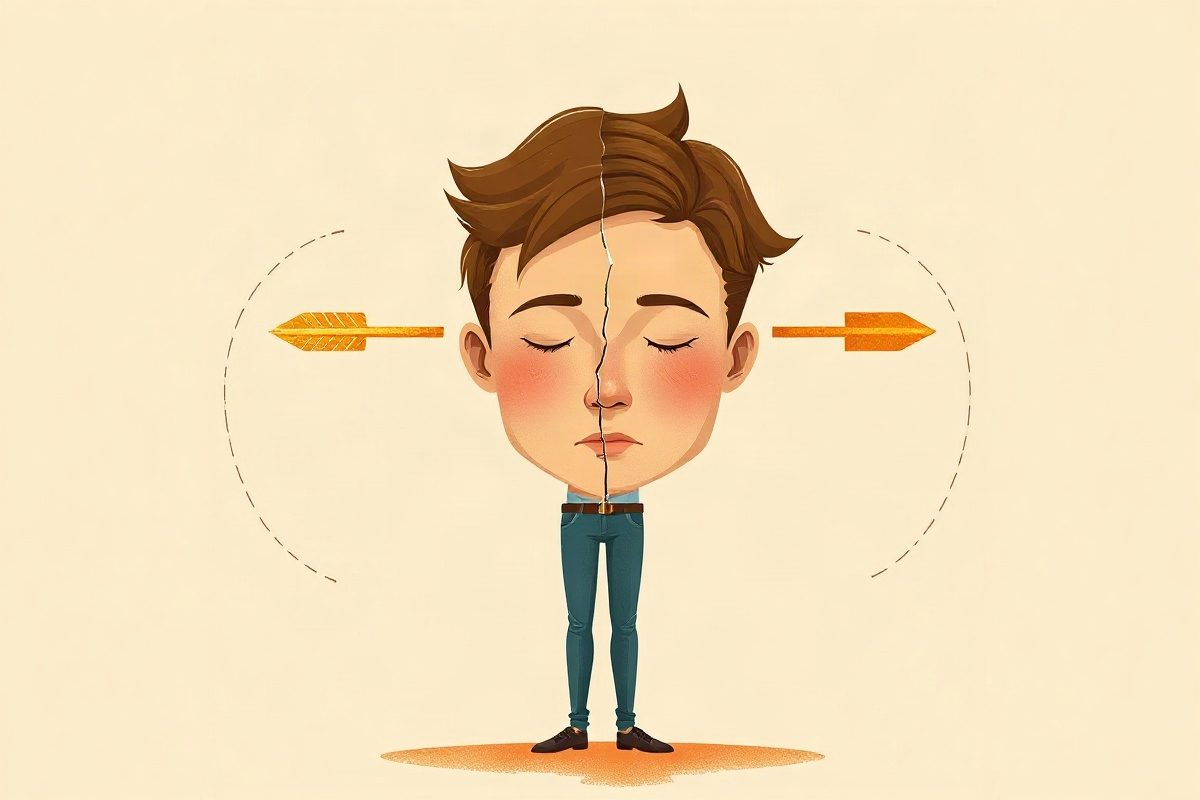
Cognitive dissonance is the mental discomfort you feel when two of your beliefs, or a belief and an action, contradict each other, and the pressure that discomfort creates to make the conflict go away. The theory comes from psychologist Leon Festinger, and its most useful insight is this: when we cannot easily change what we did, we often change what we believe instead.
You have felt it if you have ever bought something expensive and then spent the evening reading reviews that praise it, or smoked while knowing smoking is harmful, or defended a decision a little too loudly. This guide explains what cognitive dissonance is, the classic research behind it, how to recognize it in your own life, and how to use that uncomfortable feeling as information rather than something to escape.
What Is Cognitive Dissonance? The Meaning in Plain Terms
In his 1957 book A Theory of Cognitive Dissonance, Festinger proposed that people have a basic drive toward internal consistency. Our thoughts, values, and behaviors are what he called "cognitions." When two cognitions fit together, there is consonance. When one implies the opposite of the other, there is dissonance, and that state feels unpleasant in roughly the way hunger or thirst does. We are motivated to reduce it.
A simple example: "I care about my health" and "I skipped the gym for three weeks" are dissonant. The tension is stronger when the issue matters to you, when there are many conflicting cognitions, and when the behavior was freely chosen. If someone forced you to skip the gym, you would feel little dissonance. If you chose to, you feel it sharply.
Festinger described three main ways people reduce the discomfort:
- Change the behavior: go back to the gym. This is the most honest route and often the hardest.
- Change the belief: decide fitness is overrated or that you are "not a gym person."
- Add new cognitions that justify the gap: "I walk a lot anyway," "work has been brutal," "my genes are good."
The theory does not say people are irrational. It says we are rationalizing. We are skilled at producing reasons after the fact, and those reasons usually protect our sense of being a decent, competent person.
The Classic Experiments Behind the Theory
When Prophecy Fails (1956)
Before the formal theory, Festinger, Henry Riecken, and Stanley Schachter studied a small group that believed a flood would end the world on a specific date and that believers would be rescued by a flying saucer. The researchers joined the group to observe what happened when the prediction failed. Rather than abandoning the belief, the most committed members announced that their faith had saved the world and began recruiting more actively. Having given up jobs and relationships, admitting they were wrong would have been far more painful than reinterpreting the event.
The one-dollar experiment (1959)
The most famous study is Festinger and James Carlsmith's 1959 experiment. Participants spent an hour on deliberately boring tasks, such as turning pegs on a board. They were then paid either one dollar or twenty dollars to tell the next participant that the task was enjoyable. Afterward, they rated how much they had actually liked it.
The people paid one dollar rated the task as more enjoyable than those paid twenty. Twenty dollars was a sufficient reason to tell a small lie, so there was little to resolve. One dollar was not. Those participants could not easily justify lying for so little, so they quietly adjusted their attitude: maybe the task was not that bad. This is called insufficient justification, and it shows why small external rewards can sometimes shift attitudes more than large ones.
Effort justification (1959)
Elliot Aronson and Judson Mills had women go through either a mild or an embarrassing "initiation" to join a discussion group, which turned out to be dull. Those who went through the more severe initiation rated the group more favorably. When you have suffered for something, you are motivated to believe it was worth it. This helps explain why hazing builds loyalty and why people stay attached to programs, courses, or relationships that cost them a lot.
Post-decision dissonance (1956)
Jack Brehm asked participants to rate household appliances, then choose between two they had rated similarly. Later, they rated the chosen item higher and the rejected one lower than before. Psychologists call this "spreading of alternatives." After a hard choice, we inflate the winner and find faults in the loser, which helps us live with the decision.
Everyday Examples of Cognitive Dissonance
Once you know the pattern, you start seeing it everywhere:
- Buyer's justification: after an expensive purchase you seek out positive reviews and avoid negative ones.
- Health habits: "My grandfather smoked and lived to ninety" is a classic added cognition.
- Relationships: staying with someone who treats you badly can lead to minimizing the behavior, because leaving would mean admitting years were spent on the wrong person.
- Work: people in jobs that clash with their values often tell themselves "everyone does it" or "it is just business."
- Sour grapes: in Aesop's fable, the fox who cannot reach the grapes decides they were probably sour. Downgrading what you could not have is one of the oldest dissonance moves on record.
- The Benjamin Franklin effect: Franklin described winning over a rival by asking to borrow a rare book. Doing someone a favor can make you like them more, because "I helped this person" fits better with "I like this person."
Dissonance also feeds into other well-known biases. The sunk cost fallacy is partly dissonance at work: having invested heavily, quitting would clash with the belief that you make good decisions. And the tendency to overrate your own competence, described in the Dunning-Kruger effect, is easier to maintain when contradicting evidence feels threatening rather than useful.
Why Your Brain Works This Way
Later researchers refined Festinger's idea. Elliot Aronson argued that dissonance is strongest when it threatens your self-concept, particularly your view of yourself as competent, moral, and sensible. Lying for one dollar stings because it conflicts with "I am an honest person," not simply because two facts disagree.
Eddie Harmon-Jones proposed an action-based model: our brains are built to act decisively, and conflicting cognitions get in the way of acting. Reducing dissonance clears the path. Seen this way, dissonance reduction is not a flaw but a feature that sometimes misfires. It helps you commit to a choice and move on instead of being paralyzed by second-guessing.
The problem arises when the protective reflex blocks learning. If every piece of uncomfortable evidence is explained away, you never update. This is where the theory becomes practical for personal growth.
Signs You Are Experiencing Cognitive Dissonance
Dissonance rarely announces itself. It tends to show up as feelings and behaviors that look like something else:
- A defensive or irritated reaction when someone questions a choice you made.
- Avoiding information, people, or conversations on a particular topic.
- Over-explaining or rehearsing justifications in your head.
- Guilt or embarrassment that you quickly push away.
- Seeking reassurance from people you know will agree with you.
- A vague unease after acting against something you say you value.
The defensive spike is the most reliable clue. When you notice yourself arguing harder than the situation deserves, it is worth asking which belief about yourself feels threatened.
Is Cognitive Dissonance Good or Bad?
Neither, by itself. The discomfort is a signal. What matters is how you resolve it.
Resolved by rationalization, dissonance keeps you stuck: the unhealthy habit continues, the bad relationship continues, and the story you tell yourself grows more elaborate. Resolved by honest change, it is one of the strongest engines of growth you have. Researchers have used this deliberately. In "hypocrisy" studies led by Jeff Stone, Elliot Aronson, and colleagues in the 1990s, people who publicly advocated a healthy behavior and were then reminded of times they had not practiced it were more likely to change their own behavior afterward. The gap between what they preached and what they did became motivation.
This is why getting clear on your core values is so useful. Clear values make dissonance visible. You cannot feel the gap between how you live and what you care about if you have never named what you care about.
How to Work With Cognitive Dissonance Instead of Against It
1. Name the two conflicting cognitions
Write them down as two plain sentences. "I want to be financially secure." "I spent more than I earned this month." Seeing the contradiction in writing removes some of its charge and stops the automatic justification loop.
2. Separate your identity from your mistake
Much of the pain comes from "if I was wrong, I am a fool." Change the frame to "I made a choice with the information I had, and now I have more information." This is the heart of a growth mindset: errors are data about a strategy, not verdicts about you. When being wrong is no longer a threat to your self-worth, you have less reason to rationalize.
3. Notice your justifications as justifications
When you hear yourself say "everyone does it," "it is not that bad," or "I had no choice," pause and label it: "That is a dissonance-reducing thought." You do not have to argue with it. Labeling is often enough to loosen its grip.
4. Ask what evidence would change your mind
If the honest answer is "nothing," you are defending a position rather than holding a belief. Decide in advance what result would make you reconsider, then actually look for it.
5. Choose the behavior change when it is available
Changing the belief is often easier in the short term, but changing the behavior usually costs less over time. Start small. If health is the value, one walk today reduces the gap honestly. Over time, consistent action reshapes identity in a way rationalization never does.
6. Accept some discomfort as normal
Not every inconsistency needs to be fixed tonight. Adults hold complex, sometimes conflicting commitments. Being able to sit with a contradiction without rushing to resolve it is a skill. Practices like reducing overthinking help you stay with the feeling long enough to learn from it.
Cognitive Dissonance in Relationships and Self-Doubt
Dissonance also works in reverse. People with low self-esteem can feel dissonance when they succeed or receive praise, because success clashes with "I am not good enough." Instead of updating their self-image, they discount the evidence: it was luck, the test was easy, people are just being kind. This pattern is central to imposter syndrome, where capable people explain away their own competence to keep their self-concept consistent.
Recognizing this can be freeing. If your mind is rejecting good evidence about you, that is the same consistency-seeking mechanism at work, not proof that the doubt is true. Your beliefs about yourself can also shape what happens next, a loop explored in our guide to the self-fulfilling prophecy.
A Short Journal Exercise
Set aside ten minutes and answer these prompts honestly:
- What is one decision I have defended more forcefully than it deserved this year?
- Which value of mine does that decision conflict with?
- What story have I been telling to make the conflict feel smaller?
- If a friend described this situation, what would I tell them?
- What is one small action that would bring my behavior and my values closer together this week?
Repeat this once a month. The goal is not to judge yourself but to catch the rationalizations while they are still small.
The Bottom Line
Cognitive dissonance is the tension between what you believe and what you do, and the mind's quiet effort to make that tension disappear. Festinger's research and the decades of studies that followed show that we often change our beliefs to fit our actions, especially when our self-image is on the line. You cannot switch the mechanism off, but you can notice it. When you feel that defensive spike, treat it as an invitation: something you value is asking for attention, and honest change is usually the better way to answer.
Frequently Asked Questions
What is cognitive dissonance in simple terms?
It is the uncomfortable feeling of holding two ideas that contradict each other, or acting in a way that clashes with what you believe. That discomfort pushes you to restore consistency, either by changing your behavior, changing your belief, or adding justifications.
Who came up with cognitive dissonance theory?
Social psychologist Leon Festinger introduced the theory in his 1957 book A Theory of Cognitive Dissonance. His 1959 experiment with James Carlsmith, in which people paid one dollar to lie rated a boring task as more enjoyable, became the best-known demonstration.
What is an example of cognitive dissonance?
A person who values their health but smokes may tell themselves that their grandfather smoked and lived a long life. The added justification reduces the discomfort without changing the habit. Defending an expensive purchase by seeking only positive reviews is another common example.
Is cognitive dissonance a mental illness?
No. It is a normal psychological process that everyone experiences, not a diagnosis. It becomes a problem only when the urge to reduce discomfort leads you to ignore important evidence or keep harmful habits.
How do you resolve cognitive dissonance in a healthy way?
Name the two conflicting thoughts, separate the mistake from your self-worth, and notice when you are reaching for excuses. Where possible, change the behavior so it matches your values, starting with a small, concrete step.
Can cognitive dissonance be useful?
Yes. The discomfort is a signal that your actions and values have drifted apart. Research on the hypocrisy effect suggests that becoming aware of this gap can motivate people to change their behavior in a positive direction.