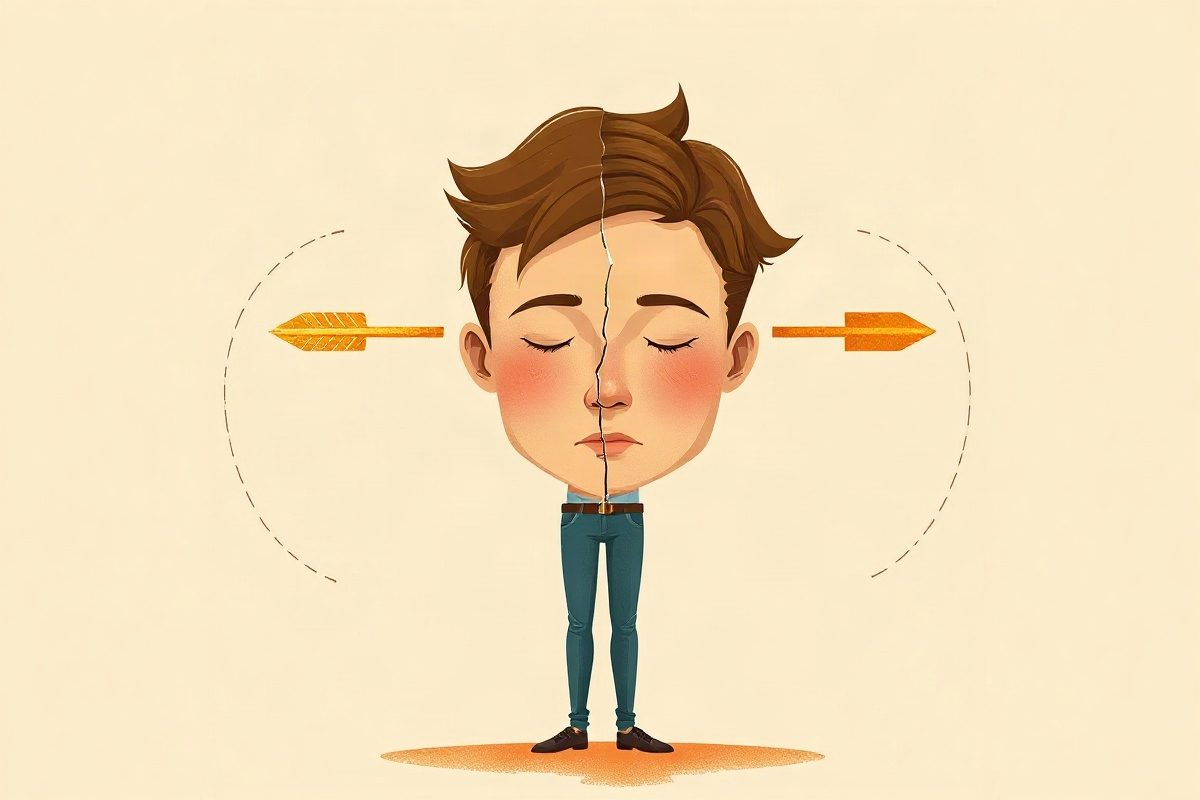
The Dunning-Kruger effect is a cognitive bias in which people with limited skill in an area tend to overestimate their ability, partly because the knowledge needed to perform well is the same knowledge needed to recognize poor performance. It was described by psychologists David Dunning and Justin Kruger in 1999, and it applies to everyone in some area of life, not just to "other people."
The idea has become an internet favorite, usually as a way to mock someone who sounds confident and wrong. That use misses most of what the research actually says. This guide explains the original study, what the effect does and does not mean, the scientific debate around it, and practical ways to calibrate your own confidence.
What Is the Dunning-Kruger Effect?
In their 1999 paper, "Unskilled and Unaware of It," published in the Journal of Personality and Social Psychology, Kruger and Dunning tested Cornell students on logical reasoning, English grammar, and the ability to judge which jokes were funny. After each test, participants estimated how well they had done compared with their peers.
The pattern was striking. People who scored in the bottom quarter substantially overestimated their performance, on average placing themselves above the middle of the group even though their actual scores were near the bottom. People in the top quarter, by contrast, tended to slightly underestimate how they compared with others.
Kruger and Dunning called the core problem a "dual burden." When you lack skill in a domain, you make more mistakes, and you also lack the expertise to spot those mistakes. Knowing what a strong argument looks like is what lets you both write one and notice that yours is weak.
The study was famously inspired by a 1995 news story about a man in Pittsburgh who robbed two banks with no disguise, believing that rubbing lemon juice on his face would make him invisible to security cameras. His confidence was complete, and so was his misunderstanding.
Why Top Performers Underestimate Themselves
The second half of the finding gets less attention. High performers did well on the tests but assumed that the material was easy for everyone. Their error was not about their own skill but about other people's. When later shown how others had performed, they adjusted their estimates upward, while low performers generally did not adjust in the same way.
This helps explain a familiar experience: the more you learn about a field, the more you realize how much you do not know, and the less certain you may sound. Charles Darwin made a related observation in The Descent of Man (1871): "Ignorance more frequently begets confidence than does knowledge." It is also part of why capable people can feel like frauds, a pattern explored in our guide to imposter syndrome. Imposter syndrome and the Dunning-Kruger effect are often described as mirror images: one inflates confidence where skill is low, the other deflates it where skill is high.
What the Dunning-Kruger Effect Is Not
Popular versions have drifted away from the research in a few important ways.
It is not about unintelligent people
The effect is domain-specific. A brilliant surgeon can show it about car repair, investing, or nutrition. Everyone is a beginner at most things, so everyone is vulnerable in most areas.
The "Mount Stupid" curve is not from the paper
You have probably seen a chart where confidence shoots up to a peak labeled "Mount Stupid," drops into a "Valley of Despair," then slowly rises along a "Slope of Enlightenment." It is a memorable cartoon, but it does not come from Kruger and Dunning's data. Their study compared different people at different skill levels at one point in time, not one person's confidence changing as they learn. The curve may describe some people's experience, but it is not what the research measured.
Low performers did not think they were the best
In the original data, the lowest scorers tended to rate themselves as somewhat above average, not as experts. The finding is about overestimation, not delusions of genius.
The Scientific Debate: Is the Effect Real?
Since 1999, researchers have debated how much of the pattern reflects a genuine psychological bias and how much is a statistical artifact.
Two well-known statistical effects can produce a similar-looking chart even when no special bias is present. The first is regression to the mean: when self-estimates are only loosely related to actual scores, extreme scorers will tend to have estimates closer to the middle. The second is the better-than-average effect: most people rate themselves as somewhat above average at most things, which naturally makes low scorers look overconfident and high scorers look modest.
Studies by Edward Nuhfer and colleagues in 2016 and 2017, and by Gilles Gignac and Marcin Zajenkowski in 2020, argued that once these factors are accounted for, the specific claim that low performers are especially bad at judging themselves becomes much weaker. Dunning and others have responded that the effect still appears under more careful methods and in real-world settings, and that the "dual burden" mechanism remains plausible.
A fair summary: people generally do tend to overestimate themselves in areas where they are inexperienced, and expertise generally does improve self-assessment. How large and how unique the original pattern is remains under discussion. Using the term as a precise diagnosis of a specific person goes well beyond what the evidence supports.
Everyday Examples
- The new driver who feels fully confident after a few months, before having encountered ice, night rain, or a real emergency.
- The first-time investor who has a lucky run in a rising market and concludes they have a talent for picking stocks.
- The weekend researcher who reads a few articles on a medical topic and feels ready to dismiss specialists.
- The new manager who assumes leading people is mainly common sense, until the first difficult conflict.
- The beginner language learner who feels nearly fluent after a few months of an app, then struggles in a real conversation.
In each case, the person is not stupid. They simply have not yet met the problems that would reveal the gaps.
How the Effect Connects to Other Biases
Overconfidence rarely acts alone. Once you have publicly committed to a confident view, admitting a gap creates cognitive dissonance, so you may defend the view rather than revise it. Having invested time or money based on that confidence can bring in the sunk cost fallacy. And because we pay close attention to our own performance, we often assume others notice our mistakes far more than they do, which is the spotlight effect, a bias that tends to make beginners more self-conscious, not less.
How to Protect Yourself From the Dunning-Kruger Effect
You cannot rely on feeling confident or unconfident, because the effect works precisely by distorting that feeling. Instead, build habits that bring in outside information.
1. Seek specific, honest feedback
Ask people with real expertise to point out what you are missing. General praise is not useful here. Ask, "What would someone more experienced do differently?" and "What is the most common mistake beginners make?"
2. Test yourself against objective standards
Take practice exams, compare your work to strong examples, or track predictions and check them later. Writing down how confident you are before you see the result, then comparing, is one of the most direct ways to calibrate.
3. Learn the basics of the field before forming strong opinions
Ironically, learning a little more often lowers confidence at first, because you start to see the complexity. That drop is a sign of progress, not failure.
4. Ask "How would I know if I were wrong?"
If you cannot describe what evidence would change your mind, your confidence is not anchored to anything you can check.
5. Adopt a learner's identity
People with a growth mindset are more likely to treat mistakes as information, which makes it easier to notice gaps rather than defend against them. When your self-worth does not depend on already being good, you can afford to see where you are not.
6. Watch your certainty, not just your knowledge
Phrases like "obviously," "everyone knows," and "it is simple" are useful warning lights in your own speech. They do not mean you are wrong, but they are worth a second look.
Using the Idea Kindly
The Dunning-Kruger effect is most useful when you apply it to yourself and least useful when you use it as an insult. Labeling someone else as a Dunning-Kruger case usually ends the conversation rather than improving it. A better approach with an overconfident colleague or friend is to ask questions that help them notice the gaps themselves, such as "What would happen if...?" or "How did you account for...?"
It is also worth remembering that confidence is not the enemy. Beginners need some confidence to start at all. The goal is calibration: confidence that roughly matches ability, and grows as ability grows. That is also why clear, honest values help, a theme in our guide on finding your core values. When honesty and learning matter more to you than looking competent, admitting what you do not know becomes far easier.
A Quick Self-Check Exercise
Pick one area where you hold a strong opinion and answer these questions in writing:
- How many hours of focused practice or study do I actually have in this area?
- Who are the recognized experts, and what would they say about my view?
- What is one thing about this topic I learned recently that surprised me?
- On a scale of 1 to 10, how confident am I, and what would move that number down?
- What is one source or person I could consult this week to test my view?
If your answers reveal more confidence than experience, you have not done anything wrong. You have simply found the next thing worth learning.
The Bottom Line
The Dunning-Kruger effect describes a real tendency: in unfamiliar areas, we often overestimate our skill because we cannot yet see our own errors, while experts sometimes underestimate how rare their knowledge is. The research is more nuanced than the popular chart suggests, and part of the pattern may be statistical. The practical lesson holds either way. Treat your confidence as a hypothesis, test it against feedback and objective results, and let your certainty grow at the same pace as your skill.
Frequently Asked Questions
What is the Dunning-Kruger effect in simple terms?
It is the tendency for people with limited skill in an area to overestimate their ability. Because they lack the knowledge to perform well, they also lack the knowledge to recognize their mistakes.
Who discovered the Dunning-Kruger effect?
Psychologists Justin Kruger and David Dunning described it in a 1999 paper titled Unskilled and Unaware of It. They tested students on logical reasoning, grammar, and humor and compared actual scores with self-estimates.
Is the Mount Stupid graph part of the Dunning-Kruger research?
No. The popular curve showing confidence peaking at Mount Stupid and then dropping into a valley is an internet illustration. The original study compared people of different skill levels at one time rather than tracking confidence as someone learns.
Is the Dunning-Kruger effect real?
The general pattern of beginners overestimating themselves is widely observed, but researchers debate how much of the original finding is a statistical artifact caused by regression to the mean and the better-than-average effect. The size and uniqueness of the effect remain under discussion.
What is the opposite of the Dunning-Kruger effect?
The original study found that top performers tended to underestimate how they compared with others, assuming tasks were easy for everyone. Imposter syndrome, in which capable people doubt their competence, is often described as a related mirror image.
How can I avoid the Dunning-Kruger effect?
Seek specific feedback from people with expertise, test yourself against objective standards, and write down predictions so you can check them later. Treat your confidence as something to verify rather than a reliable guide on its own.