
Sacred geometry symbols have fascinated spiritual seekers, artists, architects, and contemplative traditions for centuries. At first glance, they may look like simple circles, spirals, triangles, and repeating patterns. But when you sit with them slowly, these shapes can become a visual language for balance, unity, growth, protection, and inner transformation.
This guide explores the hidden meanings of sacred geometry symbols in a grounded, beginner-friendly way. You do not need to belong to a specific tradition or have advanced spiritual knowledge to benefit from them. You only need curiosity, a quiet moment, and a willingness to notice how shapes can influence your attention, emotion, and intention.
Rather than treating sacred geometry as a magic shortcut, it is healthier to understand it as a symbolic and meditative tool. A symbol can help you focus the mind. A pattern can remind you of harmony. A repeated form can invite reflection. In that sense, sacred geometry is less about superstition and more about using meaningful visual structure to support mindfulness, self-awareness, and spiritual connection.
What Are Sacred Geometry Symbols?
Sacred geometry symbols are geometric shapes and patterns that are given spiritual, philosophical, or symbolic meaning. Many of them appear in nature, religious art, temple architecture, meditation objects, mandalas, and ancient design systems. Circles can represent wholeness. Triangles can represent direction and transformation. Spirals can represent growth. Interlocking forms can represent connection and unity.
The word “geometry” itself refers to the study of shapes, space, and relationships. In a purely mathematical sense, geometry helps us understand points, lines, angles, forms, proportion, and structure. In a spiritual sense, sacred geometry asks a different question: what do these shapes awaken in our awareness?
This does not mean every geometric symbol has one fixed meaning. Symbolism changes across cultures and personal experiences. The same spiral may represent expansion to one person, healing to another, and the cycle of life to someone else. The value of sacred geometry comes from both its traditional associations and the meaning you discover through practice.
Why Geometry Feels Spiritual
Human beings naturally respond to pattern. We notice symmetry in flowers, waves, shells, snowflakes, and the night sky. We feel calm when a room is balanced. We feel drawn to shapes that repeat in pleasing ways. Sacred geometry takes this natural human response and turns it into a conscious practice.
When you meditate on a geometric symbol, your mind has something steady to rest on. The shape becomes an anchor. Instead of jumping from thought to thought, you return to the circle, the spiral, the triangle, or the center point. Over time, this simple attention can create a feeling of clarity and inner order.
The Circle: Wholeness, Unity, and Protection
The circle is one of the most universal sacred geometry symbols. It has no beginning and no end, which makes it a natural symbol of wholeness, eternity, unity, and completion. In meditation, a circle can remind you that life is not always linear. Growth often happens in cycles: beginnings, endings, pauses, returns, and renewals.
Many spiritual practices use circles as containers. People gather in circles for prayer, healing, discussion, ritual, and community. A circle can create a sense of equality because every point around it is connected to the same center. No one is above or below. Everyone belongs to the whole.
How to Work With the Circle
Use the circle when you want to feel centered, protected, or emotionally complete. You can draw a simple circle in your journal, sit quietly, and place one intention inside it. For example: “I return to myself,” “I am whole even while healing,” or “I create a peaceful boundary around my energy.”
This practice is especially useful if you are feeling scattered. The circle gives your mind a visual container. It gently says: come back to the center.
The Triangle: Direction, Change, and Inner Power
The triangle is a symbol of movement and direction. Its three sides can represent many spiritual triads: mind, body, and spirit; past, present, and future; creation, preservation, and transformation. Because it has a point, the triangle often feels focused. It rises, directs, and concentrates energy.
An upward triangle is often associated with aspiration, fire, growth, and spiritual elevation. A downward triangle may be associated with water, intuition, receptivity, and grounding into the body. Together, these two movements can represent balance between action and surrender.
Using Triangle Energy in Daily Life
Work with the triangle when you need motivation, decision-making, or courage. Draw a triangle and write one word at each corner: “clarity,” “discipline,” and “trust,” for example. Then ask yourself which corner needs more attention today. This turns the symbol into a practical self-reflection tool.
If you enjoy affirmation work, you can combine triangle symbolism with intentional language. For deeper affirmation practice, you may also explore powerful affirmations that can change your life and adapt them to your current goal.
The Spiral: Growth, Healing, and Life Cycles
The spiral is one of the most meaningful sacred geometry symbols for personal transformation. Unlike a straight line, a spiral moves outward or inward while continuing around a center. This makes it a powerful image for healing. We often revisit similar lessons at deeper levels. We may feel like we are returning to the same place, but we are not the same person each time.
In nature, spiral forms appear in shells, galaxies, storms, plants, and unfolding leaves. Spiritually, the spiral can represent evolution, inner journeying, rebirth, and the rhythm of becoming. It is a beautiful symbol for anyone doing emotional healing, shadow work, or self-discovery.
Inward and Outward Spirals
An inward spiral can represent introspection. It invites you to move toward your center, listen to your inner voice, and become honest with yourself. An outward spiral can represent expression. It invites you to bring your healing, creativity, and wisdom into the world.
If you are currently processing old emotions, the spiral can be a comforting reminder that healing is not failure when it repeats. Sometimes the same theme returns because you are ready to meet it with more compassion.
The Flower of Life: Interconnection and Creation
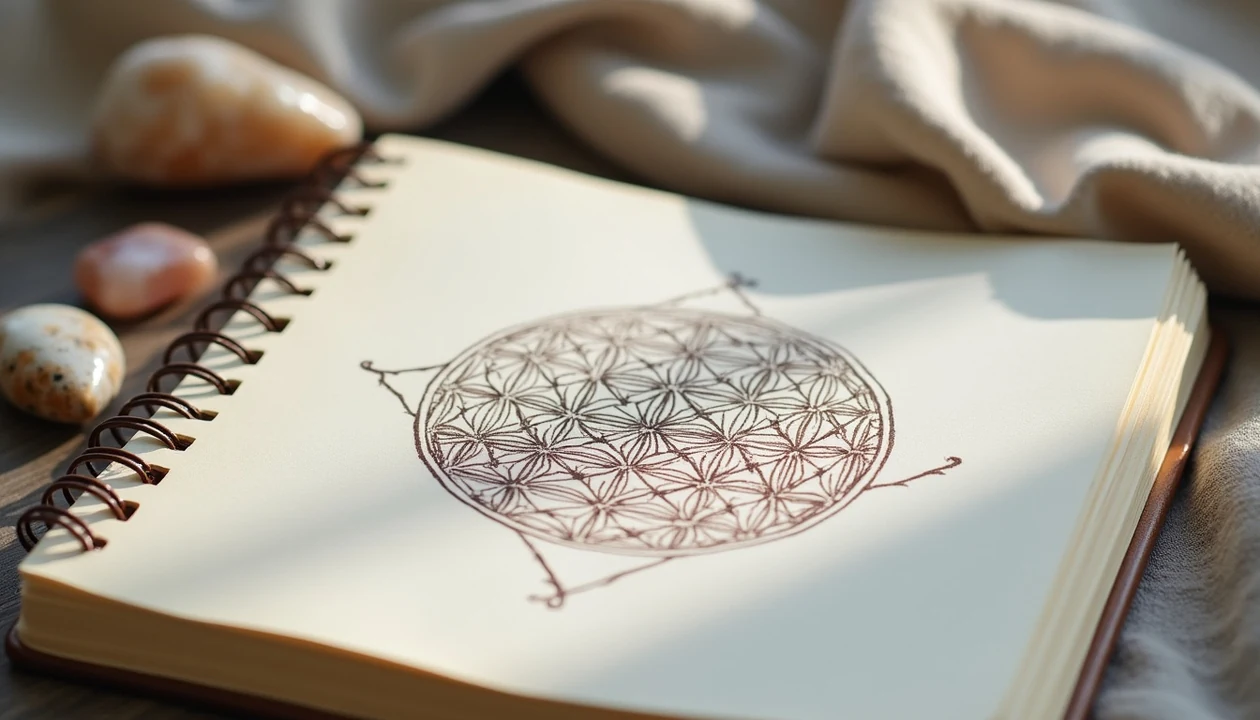
The Flower of Life is one of the most recognized sacred geometry symbols. It is made of overlapping circles that form a balanced, flower-like pattern. Many people associate it with creation, unity, divine order, and the interconnectedness of all life.
Because every circle in the pattern touches and relates to others, the Flower of Life can remind us that nothing exists in complete isolation. Your thoughts influence your actions. Your actions influence your relationships. Your relationships influence your environment. This symbol can support a more compassionate view of life because it visually expresses connection.
Meditation With the Flower of Life
To meditate with this symbol, look softly at the center of the pattern. Breathe slowly and notice how the circles expand from one point into many. You might reflect on a question such as: “Where am I forgetting that I am connected?” or “What relationship in my life needs more harmony?”
If you already practice energy cleansing, the Flower of Life can be placed near your meditation space as a reminder of energetic balance. You may also connect this with aura cleansing practices if your intention is to refresh your personal energy field.
Metatron’s Cube: Structure, Protection, and Spiritual Order
Metatron’s Cube is a complex sacred geometry symbol made from circles and lines. It contains several geometric forms within one pattern, which is why many people associate it with spiritual structure, protection, and the hidden order of creation. Visually, it can feel both intricate and balanced.
For spiritual seekers, Metatron’s Cube is often used as a protective or organizing symbol. It can represent the idea that even when life looks chaotic, deeper patterns may still exist beneath the surface. This does not mean every difficult experience is “meant to happen” or should be spiritually bypassed. Instead, the symbol can help you remember that clarity can gradually emerge from confusion.
When to Use Metatron’s Cube
Use this symbol when you need grounding, spiritual boundaries, or mental organization. It can be helpful during planning, meditation, journaling, or clearing your workspace. You might place an image of the symbol near your desk and use it as a visual cue to return to order, focus, and calm.
The Vesica Piscis: Balance Between Two Worlds
The Vesica Piscis is formed when two circles overlap. The almond-shaped space in the center is often seen as a symbol of union, creation, and the meeting point between two realities. It can represent the bridge between spiritual and physical life, intuition and logic, self and other, inner and outer worlds.
This symbol is especially meaningful for anyone learning to balance sensitivity with practical living. Many people on a spiritual path struggle with this. They may feel deeply intuitive but unsure how to apply that wisdom in daily routines, relationships, and decisions. The Vesica Piscis reminds us that spiritual insight becomes more powerful when it is integrated into real life.
A Simple Reflection Practice
Draw two overlapping circles. In the left circle, write “inner world.” In the right circle, write “outer world.” In the center, write one action that can help both sides meet. For example: “speak honestly,” “rest before deciding,” “create a morning ritual,” or “set a boundary with kindness.”
This is a simple but powerful way to turn sacred geometry into practical self-improvement.
The Seed of Life: New Beginnings and Potential
The Seed of Life is a pattern made from seven circles. It is often associated with beginnings, fertility, creation, and potential. If the Flower of Life feels like a full expression of interconnection, the Seed of Life feels like the first stage of unfolding.
This symbol is useful when you are starting something new: a habit, a healing journey, a creative project, a relationship chapter, or a spiritual practice. It reminds you that beginnings do not need to be perfect. A seed does not look like the full tree, but it carries the possibility of growth.
Working With New Intentions
Place the Seed of Life in your journal and write one intention underneath it. Keep the intention simple and believable. Instead of writing “I will transform my entire life immediately,” try “I am willing to take one honest step each day.” Sustainable spiritual growth is usually built through small, repeated choices.
Sri Yantra: Alignment, Focus, and Inner Expansion
The Sri Yantra is a sacred geometric diagram made of interlocking triangles around a central point. It is especially known in Hindu spiritual traditions and is often associated with meditation, abundance, cosmic order, and the union of masculine and feminine principles. Because of its cultural and spiritual depth, it should be approached with respect rather than treated as a decorative trend.
For beginners, the Sri Yantra can be understood as a symbol of focused awareness moving from the outer layers of experience toward the inner center. The central point, often called the bindu, can represent pure consciousness, source, or the still point within.
Respectful Use of Sacred Symbols
When using symbols from living spiritual traditions, learn their background and avoid reducing them to aesthetics. Sacred geometry is most meaningful when it is practiced with humility. If a symbol belongs to a tradition you are not part of, use it as an invitation to learn, not as something to claim casually.
How to Use Sacred Geometry Symbols in Your Spiritual Practice
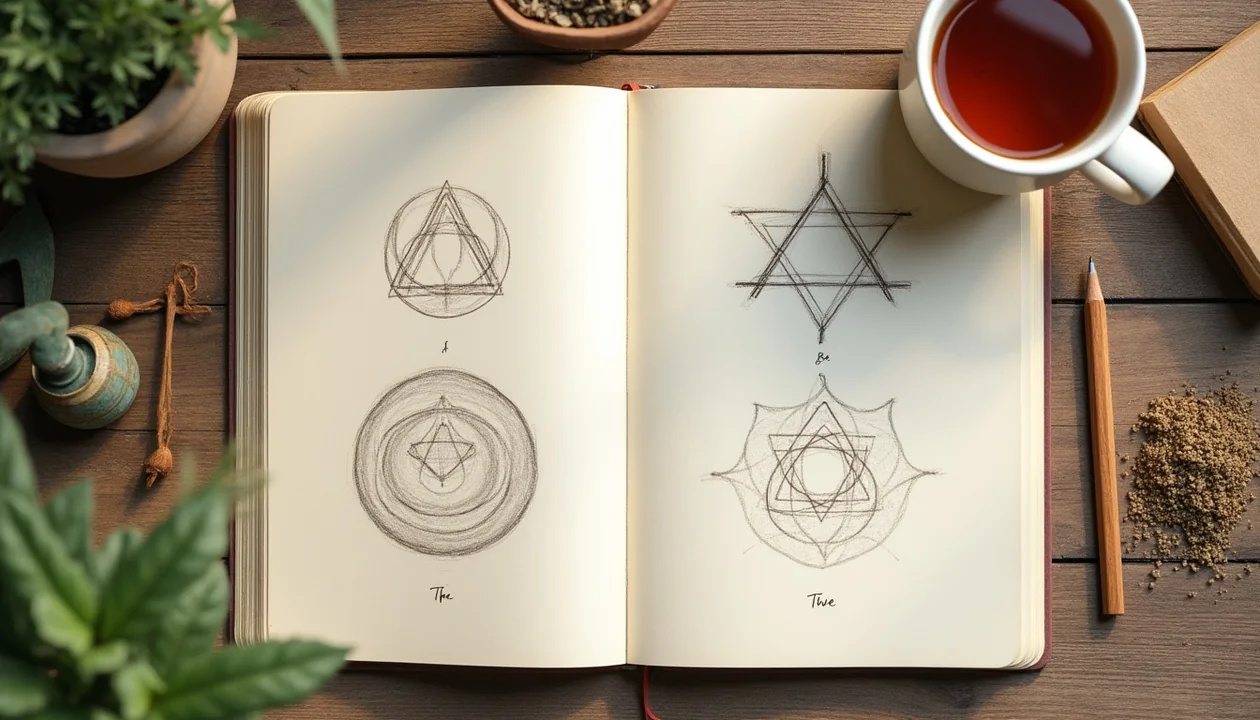
You can use sacred geometry symbols in many gentle and practical ways. The key is intention. A symbol becomes more powerful when you engage with it consciously rather than simply placing it somewhere and expecting automatic results.
1. Meditation Focus
Choose one symbol and look at it softly for three to five minutes. Let your breathing slow down. When thoughts arise, return to the shape. Notice the center, the edges, the repetition, and the feeling it creates in your body.
2. Journaling Prompt
Use the meaning of a symbol as a writing prompt. For example, with the spiral, ask: “What lesson keeps returning, and how am I meeting it differently now?” With the circle, ask: “Where do I need stronger boundaries or deeper self-acceptance?”
3. Home Energy and Decor
Sacred geometry prints, altar cloths, crystals grids, and wall art can create a calm visual atmosphere. If you enjoy working with energetic spaces, you may also like feng shui tips to attract positive energy into your home.
4. Crystal Grids
Sacred geometry is often used as a base for crystal grids. The geometric pattern helps organize stones around a focused intention. For example, a Flower of Life grid may be used for harmony, while a spiral grid may be used for transformation. If you want a structured method, read this step-by-step guide to crystal grids for manifestation.
Common Mistakes to Avoid
The first mistake is believing that a symbol will do all the work for you. Sacred geometry can support awareness, but it does not replace emotional honesty, healthy habits, therapy when needed, or real-world action. A symbol can guide your focus, but your choices still matter.
The second mistake is collecting too many symbols without understanding any of them. It is better to work deeply with one symbol for a week than to surround yourself with ten symbols you barely notice. Spiritual practice becomes stronger through presence, not quantity.
The third mistake is using sacred symbols without respect for their origin. Some symbols are connected to specific religions, cultures, or lineages. Learning context is part of ethical spiritual practice.
Are Sacred Geometry Symbols Scientifically Proven?
Geometry as a field is well established, and you can learn more about its mathematical foundations from resources such as Britannica’s overview of geometry. However, the spiritual meanings of sacred geometry symbols are symbolic, cultural, and experiential rather than scientifically proven in the same way a laboratory measurement would be.
This distinction matters. You can appreciate sacred geometry without making exaggerated claims. A symbol may help you feel calmer, more focused, or more connected because it gives your mind a meaningful anchor. That personal experience can be valuable even when it is not a scientific guarantee.
Geometric patterns have also played an important role in art and sacred architecture. For example, the Metropolitan Museum of Art discusses the importance of geometric patterns in Islamic art, showing how repetition, symmetry, and proportion can carry aesthetic and spiritual significance across cultures.
Choosing the Right Sacred Geometry Symbol for You
If you are new to sacred geometry, begin with the symbol that naturally attracts your attention. You do not have to force a complicated interpretation. Ask yourself what you need most right now. If you need peace, begin with the circle. If you need courage, begin with the triangle. If you are healing, begin with the spiral. If you want connection, begin with the Flower of Life. If you need boundaries and structure, begin with Metatron’s Cube.
Then spend a few days observing how the symbol affects your practice. Does it help you slow down? Does it bring up emotions? Does it remind you of a lesson? Does it inspire action? Your relationship with a symbol should feel alive, not mechanical.
Final Thoughts on Sacred Geometry Symbols
Sacred geometry symbols offer a beautiful bridge between visual beauty and inner meaning. They can help you meditate, journal, set intentions, create peaceful spaces, and reflect on the deeper patterns of life. Their hidden meanings are not only found in ancient traditions; they are also discovered through your own honest attention.
Start simply. Choose one symbol. Learn its background. Sit with it quietly. Write about what it brings up. Use it as a reminder to return to balance, compassion, and awareness. Over time, sacred geometry can become more than a set of shapes. It can become a gentle map for your spiritual growth.


