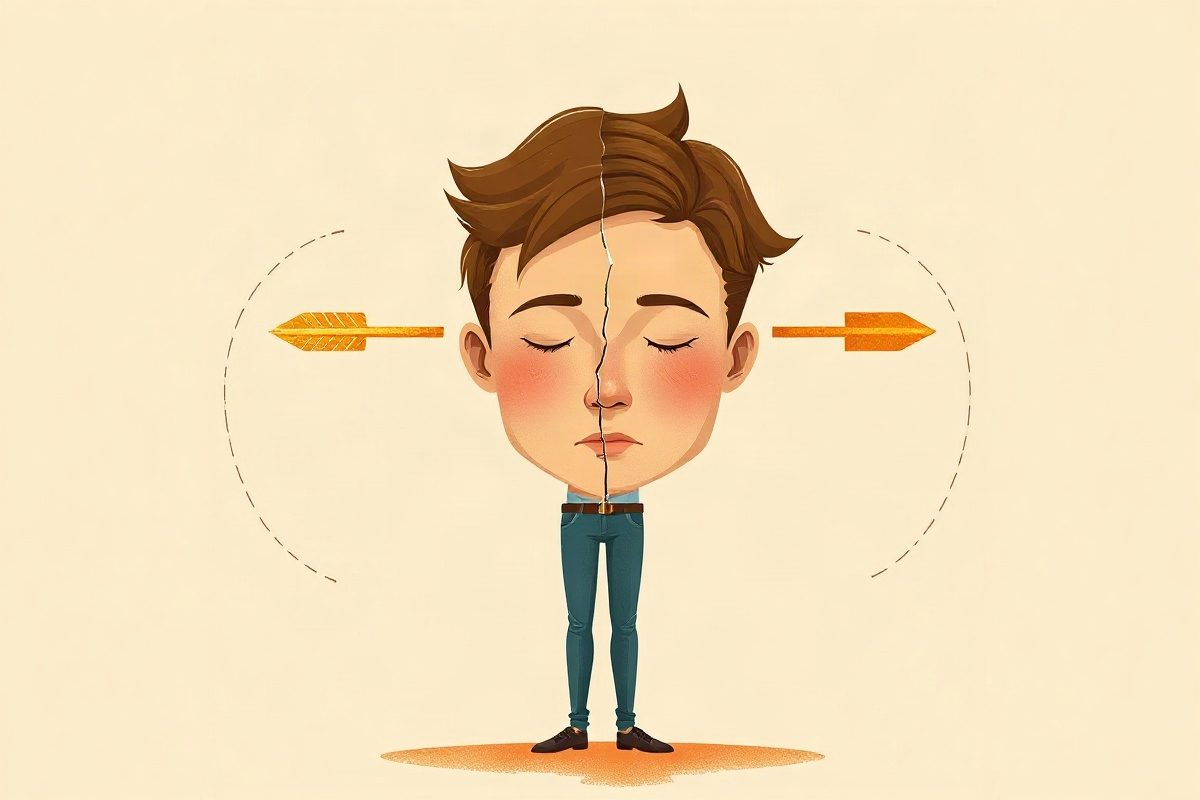
The spotlight effect is the tendency to overestimate how much other people notice and remember your appearance, mistakes, and behavior. It feels as if a spotlight follows you everywhere, but in reality most people are busy thinking about themselves, and your awkward moment usually fades from their minds long before it fades from yours.
Understanding this bias can be surprisingly freeing. Once you know how consistently people overestimate their own visibility, it becomes easier to speak up, try new things, and recover from embarrassing moments. This guide explains the research behind the spotlight effect, why it happens, where it shows up, and practical ways to step out of the imaginary glare.
What Is the Spotlight Effect?
The term was introduced by psychologists Thomas Gilovich, Victoria Husted Medvec, and Kenneth Savitsky in a 2000 paper in the Journal of Personality and Social Psychology. They defined it as people's tendency to believe that the social spotlight shines more brightly on them than it actually does. Whether it is a bad hair day, a stumble over words in a meeting, or a stain on your shirt, you tend to assume that others notice it more, and judge it more, than they really do.
The spotlight effect is a form of egocentric bias. You experience your own life from the inside, with every detail of your appearance and every misstep vividly present in your awareness. It is easy to assume that what is so obvious to you must be equally obvious to everyone else.
The Barry Manilow T-Shirt Study
The best-known demonstration of the spotlight effect involved a T-shirt. In one of the experiments reported by Gilovich and colleagues, college students were asked to put on a T-shirt featuring a large image of singer Barry Manilow, a choice that students at the time found embarrassing. Each participant then walked into a room where a group of peers was filling out questionnaires, stayed briefly, and left.
Afterward, the T-shirt wearers were asked to estimate how many people in the room had noticed who was on their shirt. They guessed roughly half. When the researchers asked the observers, only about a quarter could correctly name the person on the shirt. The wearers overestimated how noticeable they were by a wide margin.
In other studies in the same paper, participants overestimated how much their contributions to a group discussion, both their good points and their blunders, stood out to others. The effect applied in both directions: people thought their mistakes were more memorable than they were, but also that their impressive moments were more memorable than they were.
Why the Spotlight Effect Happens
Anchoring on your own experience
Gilovich and colleagues proposed that the spotlight effect results from anchoring and adjustment. When you try to estimate how others see you, you start from your own perspective, where the embarrassing detail is front and center, and then try to adjust for the fact that others are not inside your head. The adjustment is usually insufficient. You move away from your own view, but not far enough. Later work by Nicholas Epley and colleagues, published in 2004, described perspective-taking more generally as this kind of egocentric anchoring followed by incomplete correction.
Everyone is in their own spotlight
The other half of the explanation is simple: other people are busy. They are thinking about their own appearance, their own worries, the conversation they need to have later, and whether they said something awkward a moment ago. Each person in the room is standing in a spotlight of their own making, which leaves little attention for yours.
The illusion of transparency
A closely related bias is the illusion of transparency, described by Gilovich, Savitsky, and Medvec in 1998. People tend to overestimate how clearly their internal states, such as nervousness or discomfort, are visible to others. In their studies, people who were asked to lie overestimated how easily observers could detect it, and speakers who felt anxious believed their nerves were more apparent than audiences reported. You feel your racing heart and shaking hands so vividly that you assume everyone can see them.
The imaginary audience
Developmental psychologist David Elkind described a similar pattern in adolescents in 1967, calling it the "imaginary audience": the feeling that everyone is watching and evaluating you. The spotlight effect research suggests that this tendency does not disappear after the teenage years. It simply becomes less intense for most people, while remaining strong in moments of stress or self-doubt.
We Also Overestimate How Harshly We Are Judged
It is not only that people notice us less than we think. When they do notice a mistake, they tend to judge it less harshly than we fear. In a 2001 study, Kenneth Savitsky, Nicholas Epley, and Thomas Gilovich asked participants to imagine or experience embarrassing situations, such as an intellectual failure in front of others. Participants predicted that observers would judge them more harshly than observers actually did.
The reason is that you focus intensely on the single blunder, while observers see it in a wider context. They take into account the situation, the fact that everyone makes mistakes, and everything else they know about you. They also tend to be more charitable than you assume, partly because they can easily imagine making the same mistake themselves.
Related research on what has been called the "liking gap," published by Erica Boothby and colleagues in 2018, found that after conversations with strangers, people tended to underestimate how much their conversation partner liked them. The pattern is consistent: we are harder on ourselves in social situations than other people are.
Where the Spotlight Effect Shows Up
- Appearance. A pimple, an outfit you are unsure about, or hair that would not cooperate can make you feel conspicuous all day, even though few people register it.
- Speaking up. You may hold back an idea in a meeting because you fear stumbling over your words. In reality, small stumbles are rarely remembered by anyone else.
- Social mistakes. Forgetting someone's name, laughing at the wrong moment, or sending a message with a typo can feel mortifying in the moment and fade quickly for everyone else.
- Trying something new. Starting at a gym, joining a dance class, or learning a language can feel exposing. Most people around you are concentrating on their own workout or their own steps.
- Online life. It is easy to believe everyone noticed a post that received few likes. Most people scroll past without forming any opinion.
- Life decisions. Changing careers or leaving a long project can feel like it will be watched and judged. Fear of how quitting looks is one of the forces behind the sunk cost fallacy.
How the Spotlight Effect Holds You Back
A little self-awareness is healthy. It helps you read social situations and adjust your behavior. But an overactive sense of being watched can quietly shrink your life. It can lead you to:
- Avoid opportunities because you fear looking foolish.
- Replay minor social moments for hours, feeding a cycle described in our guide on how to stop overthinking.
- Agree to things you do not want in order to avoid any possible disapproval.
- Measure yourself constantly against others, assuming they are measuring you just as closely. Our article on how to stop comparing yourself can help with that loop.
- Feel like a fraud who is about to be found out, which overlaps with imposter syndrome.
The spotlight effect also teams up with negativity bias. Your own mistakes feel bigger than your successes, and you assume that others are fixated on those mistakes too. The result is a distorted picture in which your worst moments are both larger and more public than they really are.
How to Overcome the Spotlight Effect
1. Remember the research in the moment
Simply knowing about the spotlight effect can help. In a 2003 study, Kenneth Savitsky and Thomas Gilovich found that people who were told about the illusion of transparency before giving a speech felt less anxious and were rated as better speakers than those who were not told. When you feel self-conscious, remind yourself: "People are noticing me far less than it feels like."
2. Flip the perspective
Think about the last time someone else made a small mistake in front of you, such as tripping slightly, mispronouncing a word, or wearing a mismatched outfit. Do you remember it? Did you judge them for it? Most people realize they barely noticed or quickly forgot. Others extend you the same indifference and kindness.
3. Shift your attention outward
Self-consciousness thrives on inward focus. When you notice yourself monitoring how you look or sound, deliberately turn your attention to the other person: what are they saying, what are they interested in, how are they feeling? Curiosity about others is one of the most reliable ways to step out of your own spotlight, and it usually makes you better company too.
4. Run a small exposure experiment
Choose something mildly uncomfortable that you have been avoiding, such as asking a question in a meeting, wearing something bolder than usual, or eating alone in a café. Before you do it, write down what you predict people will notice and think. Afterward, write down what actually happened. Repeating this a few times gives you personal evidence that the spotlight is dimmer than you expected.
5. Treat mistakes as normal and survivable
Everyone fumbles words, forgets names, and misreads situations. A growth mindset helps you see these moments as part of learning rather than proof of inadequacy. When you make a mistake, acknowledge it lightly, laugh if it fits, and move on. Your relaxed response often becomes what people remember, if they remember anything at all.
6. Use a confidence anchor
Before a situation that makes you self-conscious, take a few slow breaths and repeat a short phrase that grounds you. Phrases such as "Most people are focused on themselves" or "I am allowed to take up space" can help. If you like working with affirmations, our collection of affirmations for confidence offers more options.
7. Talk back to the replay
When you catch yourself replaying an awkward moment hours later, ask three questions: Who else is likely thinking about this right now? What would I say to a friend who told me this story? What did I do well in that same situation? The goal is not to dismiss your feelings but to put them in proportion.
A Journal Practice for Self-Consciousness
For one week, keep a short "spotlight log." Each time you feel self-conscious, write down:
- The situation and what you thought people noticed.
- How strongly you felt watched, on a scale of 1 to 10.
- Any evidence that others actually noticed, such as comments, looks, or follow-up.
- How you feel about the moment a day later.
At the end of the week, read through your entries. Most people discover that the evidence column is nearly empty and that the intensity dropped sharply within a day. That record becomes something you can return to the next time the spotlight feels blinding.
The Bottom Line
The spotlight effect is a normal product of living inside your own head. You see every detail of yourself, so you assume others do too. Research consistently shows otherwise: people notice less, remember less, and judge less harshly than you fear. You do not need to stop caring what others think entirely. You only need to adjust your estimate to fit reality. When you do, you gain freedom to speak up, try new things, and let small mistakes be as small as they really are.
Frequently Asked Questions
What is the spotlight effect in psychology?
The spotlight effect is the tendency to overestimate how much other people notice your appearance, behavior, and mistakes. The term was introduced by Thomas Gilovich, Victoria Husted Medvec, and Kenneth Savitsky in 2000. It happens because we experience ourselves vividly from the inside and assume others see us just as clearly.
What was the Barry Manilow T-shirt experiment?
In that study, students wore an embarrassing Barry Manilow T-shirt into a room of peers. They estimated that about half the people noticed the shirt, but only about a quarter of observers could identify it. The gap showed how much people overestimate their own visibility.
What is the difference between the spotlight effect and the illusion of transparency?
The spotlight effect is about overestimating how much others notice your outward appearance and actions. The illusion of transparency is about overestimating how clearly others can see your inner states, such as nervousness or discomfort. Both are forms of egocentric bias and often occur together.
Is the spotlight effect linked to social anxiety?
The spotlight effect is a normal bias that affects most people, but it can feel especially strong for those with social anxiety. Feeling constantly watched can lead to avoidance and overthinking. If self-consciousness significantly limits your daily life, a mental health professional can help.
How do I stop feeling like everyone is watching me?
Remind yourself that most people are focused on themselves, and recall how little you notice other people's small mistakes. Shift your attention outward to the person you are talking with, and test your predictions with small exposure experiments. Over time, the evidence helps recalibrate your sense of being watched.
Do people judge our mistakes as harshly as we think?
Usually not. Research by Savitsky, Epley, and Gilovich in 2001 found that people expected observers to judge their embarrassing moments more harshly than observers actually did. Others tend to see mistakes in context and are often more forgiving than we expect.