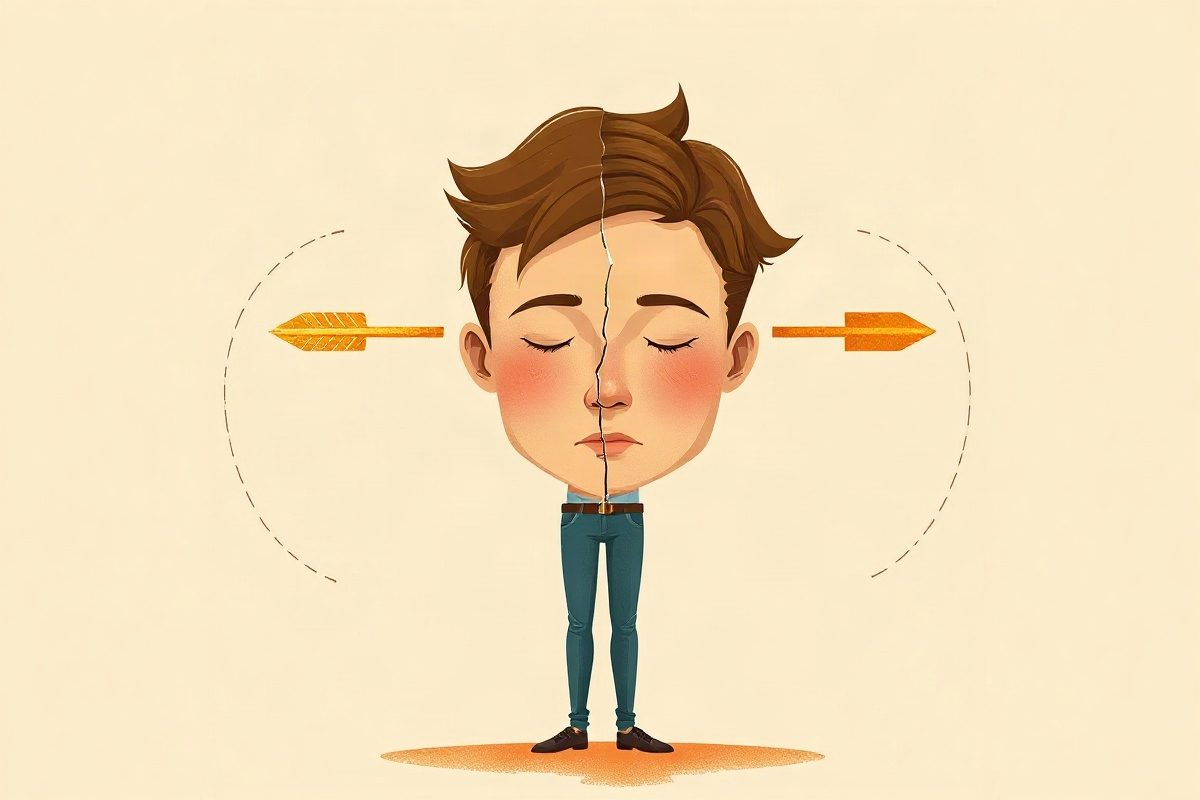
The halo effect is the tendency to let one positive impression of a person, product, or organization shape your judgment of their other, unrelated qualities. If someone is attractive, confident, or impressive in one area, you are more likely to assume they are also kind, competent, and trustworthy, often without any direct evidence.
The halo effect is one of the oldest documented biases in psychology, and it shows up everywhere: job interviews, classrooms, dating, brand loyalty, and even how you judge yourself. This guide covers where the term came from, the key studies, its mirror image (the horns effect), real-life examples, and practical ways to make fairer judgments.
What Is the Halo Effect?
The halo effect happens when a general impression spills over into specific judgments. Instead of evaluating each quality separately, your mind forms an overall feeling, "I like this person" or "this company seems good," and then fills in the details to match that feeling.
The name comes from the image of a halo in religious art: a single glowing feature that makes the whole figure appear good. In psychological terms, it is a kind of consistency shortcut. The mind prefers a coherent story, and it is more comfortable when the people and things we like are good in every way.
A few features make the halo effect distinctive:
- It crosses categories. A trait in one domain (appearance, fluency, status) influences ratings in an unrelated domain (intelligence, honesty, skill).
- It works quickly. First impressions form within moments and can shape everything that follows.
- It is usually invisible. People typically believe their judgments were based on the specific qualities they rated, not on an overall feeling.
The Origins: Thorndike's Constant Error (1920)
American psychologist Edward Thorndike named the effect in a 1920 paper titled "A Constant Error in Psychological Ratings." He examined how military officers rated their soldiers on qualities such as physique, intelligence, leadership, and character. These should have been fairly independent traits; a soldier can be physically strong without being especially bright, or loyal without being a natural leader. Yet Thorndike found that the ratings were far more strongly correlated than they should have been. Officers seemed to form one overall impression of each man and then rate every trait in line with it.
Thorndike called this a "constant error" because it was not random. It pushed ratings in a predictable direction, and the officers did not appear aware of it. A century later, the same problem shows up in performance reviews, school grading, and customer surveys.
Key Studies on the Halo Effect
"What is beautiful is good" (Dion, Berscheid & Walster, 1972)
Karen Dion, Ellen Berscheid, and Elaine Walster showed participants photographs of people who varied in physical attractiveness and asked them to guess the personalities and life outcomes of each person. More attractive people were judged as more sociable, more successful, and more likely to have happy marriages and good careers. A later meta-analysis by Alice Eagly and colleagues (1991) found that this "beauty is good" stereotype is real but narrower than the slogan suggests: it is strongest for judgments of social skills and weaker for traits such as integrity or concern for others.
Attractiveness and essay grades (Landy & Sigall, 1974)
David Landy and Harold Sigall had participants grade essays that came with a photo of the supposed author. When the essay was weaker, an attractive author's photo led to noticeably better ratings than an unattractive one. The quality of the writing had not changed, only the impression of the writer.
The warm and cold lecturer (Nisbett & Wilson, 1977)
Richard Nisbett and Timothy Wilson showed students one of two videos of the same lecturer, who spoke with a European accent. In one version he was warm and friendly; in the other, cold and rigid. Students who saw the warm version rated his appearance, mannerisms, and accent as appealing, while those who saw the cold version rated the same features as irritating. Strikingly, the students insisted that their liking for the lecturer had not influenced their ratings of his appearance. Some even suggested the causation ran the other way. This is the core lesson of the study: people are often unaware of what is driving their judgments.
Halos in business (Rosenzweig, 2007)
In his book The Halo Effect, business professor Phil Rosenzweig argued that much management writing is distorted by the bias. When a company is performing well, observers tend to describe its strategy as brilliant, its culture as strong, and its leaders as visionary. When the same company falls on hard times, the same strategy is described as reckless and the same culture as complacent. Performance creates a halo, and the halo is then mistaken for the cause of the performance.
The Horns Effect: The Negative Version
The halo effect has a mirror image, often called the horns effect (or reverse halo). One negative trait, a poor first impression, a nervous handshake, an unfamiliar accent, a typo on a résumé, leads you to judge other qualities more harshly. Because the mind gives extra weight to bad information, a pattern described in negativity bias, a single negative cue can sometimes be harder to shake than a positive one.
The horns effect is particularly important in hiring, teaching, and any setting where early mistakes are remembered. A student who struggles in the first week may be labeled a weak student, and later improvement may not be fully noticed.
Everyday Examples of the Halo Effect
Job interviews and workplaces
A candidate who is articulate and well dressed may be rated as more competent overall, even on skills the interview never tested. At work, an employee known for one standout project may receive higher ratings across every category in a performance review. Managers who use a single overall impression to fill in ten separate rating boxes are repeating Thorndike's constant error.
Dating and relationships
Physical attraction or charisma can make it easy to assume someone is also kind, reliable, and emotionally mature. Early romance often runs on halos. This is one reason it helps to look at concrete behavior over time, the kind of evidence described in green flags in relationships, rather than relying on how a person makes you feel in the first few dates.
Celebrities and experts
Fame or expertise in one field often lends credibility in unrelated fields. A respected actor's view on nutrition, or a successful entrepreneur's view on medicine, can feel more authoritative than it should. Advertisers use this deliberately when they choose spokespeople.
Brands and products
If you love one product from a company, you are likely to assume its other products are also excellent. A sleek design can make a device seem more reliable. "Health halos" are common in food marketing: a single positive label such as "organic" or "low fat" can make people underestimate calories or overlook other ingredients.
Classrooms
Teachers, like everyone else, can be influenced by neatness, politeness, or a student's past reputation when grading. Daniel Kahneman, in Thinking, Fast and Slow (2011), described noticing that his grading of exam answers was swayed by how well a student had done on the first answer. His fix was to grade one question across all students before moving to the next, so that each answer was judged on its own.
The Halo Effect and How You See Yourself
Halos and horns do not only apply to other people. You can apply them to yourself. If you feel you failed in one important area, a breakup, a lost job, a health problem, the horns effect can spread that sense of failure to everything: "I am bad at relationships, so I am probably bad at work too." On the other hand, success in one area can create blind spots in another.
This is part of why capable people can feel like frauds. One perceived weakness colors their whole self-assessment, a pattern explored in imposter syndrome. It also connects to the spotlight effect: we tend to assume others are paying more attention to our flaws than they actually are, which can make a single awkward moment feel like it defines us.
How the Halo Effect Connects to Other Biases
The halo effect rarely acts alone. Once you have formed a positive impression, confirmation bias makes you more likely to notice evidence that supports it and discount evidence that does not. Over time, your expectations can even shape how the other person behaves. Teachers who expect more from a student may give that student more attention and encouragement, which can lead to better performance, a pattern linked to the self-fulfilling prophecy.
How to Reduce the Halo Effect
As with most biases, simply knowing about the halo effect does not make you immune. The Nisbett and Wilson study shows that people cannot reliably see it in themselves. What helps is structure: setting up your decisions so that one impression has less room to spread.
1. Judge one quality at a time
Follow Kahneman's approach. When evaluating several people or options, rate everyone on one criterion before moving to the next. This prevents a strong first rating from setting the tone for everything else.
2. Define criteria before you meet the person
In hiring, decide in advance what skills matter and how you will measure them. Structured interviews, in which every candidate gets the same questions scored against the same standards, are widely recommended in organizational psychology precisely because they limit the influence of overall impressions.
3. Remove irrelevant information when you can
Blind review is one of the most effective tools. Grading work without names, reviewing writing samples without photos, or evaluating proposals without knowing who submitted them removes the trigger for the halo.
4. Ask "What do I actually know?"
When you feel strongly about someone, separate observed facts from inferences. "She gave a confident presentation" is an observation. "She would be a great team leader" is an inference. Write down the evidence for each conclusion and see which ones are standing on their own.
5. Delay the final judgment
First impressions are fast. Fair impressions usually need more data. In relationships, friendships, and business partnerships, give yourself time to see how someone behaves across different situations, especially under stress, before deciding who they are.
6. Look for the horns, too
Ask yourself whether a single negative detail is coloring your view. Was the candidate's nervousness in the first minute really relevant to the job? Is a friend's one careless comment outweighing years of kindness?
A Simple Reflection Exercise
Think of one person you admire and one person who irritates you. For each, make two columns:
- What I have directly observed: specific actions, words, results.
- What I have assumed: traits, motives, and abilities you have filled in without direct evidence.
Most people find that the "assumed" column is longer than expected, and that it closely follows their overall feeling about the person. The exercise does not mean your feelings are wrong. It means they are doing more of the work than you realized, and it gives you a clearer picture of where your judgment is solid and where it is borrowed. Doing the same exercise about yourself can be surprisingly freeing, and it fits naturally with practices for learning to trust yourself on a more realistic basis.
Why the Halo Effect Persists
The halo effect exists because the mind is built to form quick, coherent impressions with limited information. In many everyday situations, that is efficient and roughly accurate. The trouble comes when the stakes are high and the halo replaces careful evaluation. You will never stop forming first impressions, and you do not need to. The goal is to notice when one bright or dark feature is doing all the talking, and to give the other qualities a fair hearing.
Frequently Asked Questions
What is the halo effect in simple terms?
The halo effect is when one good quality, such as attractiveness, confidence, or a famous name, makes you assume a person or product is good in other, unrelated ways too. Your overall impression spills over into specific judgments.
Who discovered the halo effect?
Psychologist Edward Thorndike named it in a 1920 paper, after finding that military officers' ratings of soldiers on separate traits were far more closely linked than they should have been. The officers appeared to form one general impression and rate every trait to match it.
What is the opposite of the halo effect?
The opposite is usually called the horns effect or reverse halo. A single negative trait or poor first impression leads you to judge a person's other qualities more harshly than the evidence supports.
What is an example of the halo effect at work?
An employee who delivered one impressive project may receive high ratings in every category of a performance review, including areas where their work is average. Similarly, a polished, articulate job candidate may be assumed to have technical skills the interview never tested.
How can you avoid the halo effect?
Use structure: set criteria in advance, rate one quality at a time across all candidates or options, and remove irrelevant information such as photos or names when possible. Separating what you have actually observed from what you have assumed also helps.
Is the halo effect related to confirmation bias?
Yes. Once a positive impression forms, confirmation bias makes you more likely to notice evidence that supports it and overlook evidence that does not. The two biases often reinforce each other.