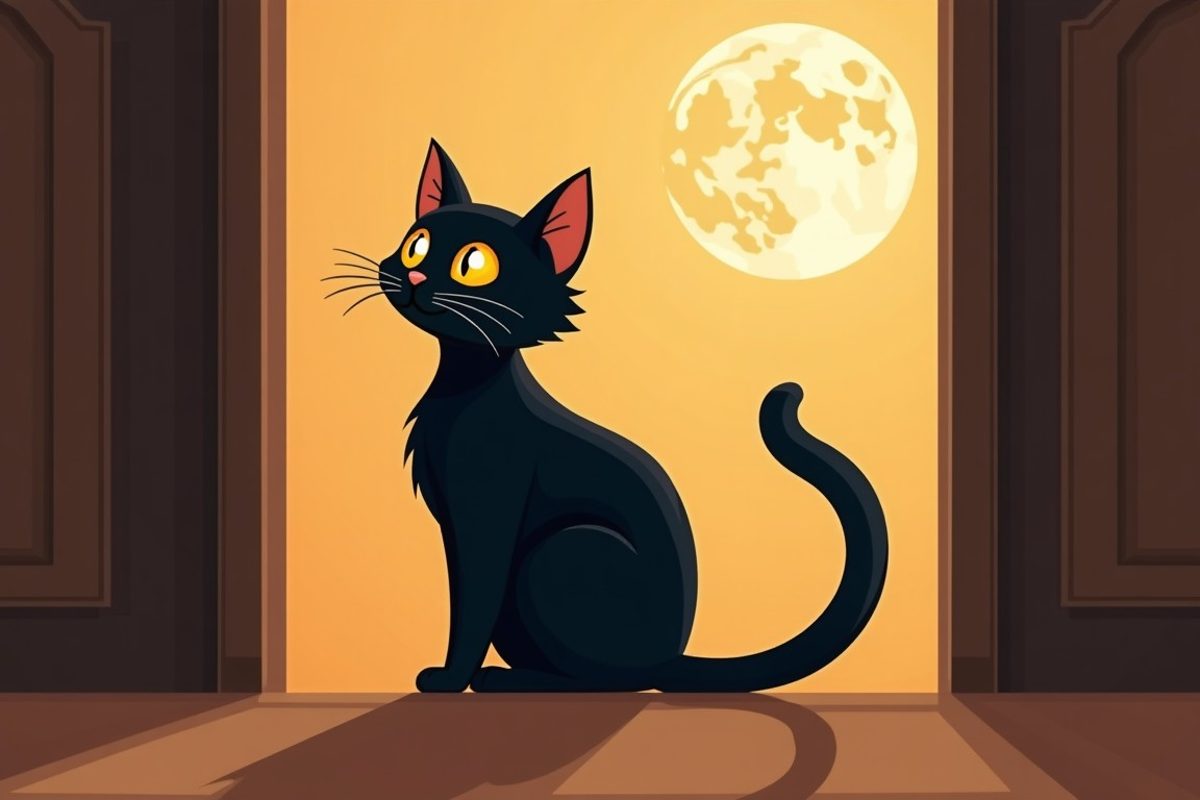
The spiritual meaning of a black cat crossing your path depends on where you are: in the United States and much of continental Europe it is traditionally bad luck, while in Britain, Ireland, Scotland, and Japan it is often considered good luck. Spiritually, most modern readers interpret it as a sign of protection, intuition, and a moment to pause, not as a curse.
Few animals carry as much contradictory folklore as the black cat. It has been a witch's familiar, a sailor's charm, a wedding gift, a fairy creature, and a symbol of independence. This guide sorts out which beliefs come from where, what a black cat can mean for love and loss, in dreams, and as a spirit animal, and what to actually do the next time one strolls across your path.
Is a Black Cat Crossing Your Path Good or Bad Luck?
Both, depending on the tradition. That split is the most important thing to understand about black cat symbolism.
- Bad luck traditions: In the United States, Germany, Italy, Spain, and many other parts of Europe, a black cat crossing in front of you has long been considered an ill omen. Some versions say the direction matters, for example that crossing from right to left is worse, but the details vary from region to region.
- Good luck traditions: In parts of Britain, a black cat crossing your path or arriving at your door is lucky. In Scotland, a strange black cat appearing at your home was said to bring prosperity. In Japan, black cats have been associated with good fortune and with warding off evil.
So if you were raised to fear black cats, that is a cultural inheritance, not a universal spiritual law. Half the world would congratulate you for the same encounter.
Where the Beliefs Come From
Ancient Egypt: reverence, not fear
Cats in general were highly valued in ancient Egypt, associated with the goddess Bastet, a protector of the home, of women, and of childbirth. Killing a cat could be severely punished. It is often said online that Egyptians revered black cats specifically; the evidence points more to cats in general, so treat that detail with care. What is clear is that the earliest large-scale human relationship with cats was one of respect.
Medieval Europe: witches and familiars
The darker reputation grew in medieval and early modern Europe. In 1233 Pope Gregory IX issued the letter Vox in Rama, which described an alleged heretical ritual involving a black cat. Popular accounts claim it triggered mass killings of cats; historians debate how much effect it really had. Either way, black cats became tied to heresy, the devil, and later to witchcraft. During the witch trials of the sixteenth and seventeenth centuries, cats were often named as witches' familiars, spirits in animal form that supposedly served them. A black cat crossing your path came to be read as a witch or a demon interfering with your road.
That reputation sailed with European settlers to North America, which is one reason the bad luck belief remains strong in the United States today, and why black cats became a Halloween image.
British, Irish, and Scottish folklore: luck and the Cat Sìth
Britain kept a very different thread alive. Black cats were considered lucky in many parts of England, and a black cat at a wedding, or given as a wedding gift, was said to bring happiness to the couple. Sailors often kept ship's cats and considered black ones especially lucky, and stories say fishermen's wives kept black cats at home to protect their husbands at sea.
Scottish Highland folklore adds the Cat Sìth, a fairy creature described as a large black cat with a white spot on its chest. It was feared for supposedly stealing the souls of the dead before burial, but at Samhain families who left out a saucer of milk for it were said to be blessed. So even in one region, the black cat was both dangerous and generous, depending on how it was treated.
France: the matagot
Southern French folklore tells of the matagot, a magical cat, often black, that brings wealth to a household that feeds and treats it well. Again, the black cat is not simply good or bad. It rewards respect.
Japan: fortune and protection
In Japanese folk belief, black cats have been associated with luck and protection, and some traditions held that a black cat could help a single woman attract suitors. Black versions of the beckoning-cat figurine, the maneki-neko, are commonly sold as charms to ward off bad influences.
The Modern Spiritual Meaning of a Black Cat
Most contemporary spiritual readers set aside the witch-trial fear and focus on the qualities cats actually show. When a black cat crosses your path, common interpretations include:
- Protection. Black is associated with absorbing and shielding in many energy traditions, and cats are fiercely self-protective. A black cat is often read as a sign that you are guarded, or that you need to guard your energy better.
- Intuition and the unseen. Cats see well in low light and seem to notice things we miss. The black cat invites you to trust what you sense before you can explain it.
- A pause point. Something literally steps across your path. Many people read this as an invitation to stop and reconsider a choice before continuing.
- Independence and self-trust. Cats do what they choose. A black cat can be a nudge to act on your own judgment rather than other people's expectations.
- Transformation and the shadow. Black is the color of the unknown, of night, and of the parts of ourselves we avoid. A black cat may point toward shadow work and toward integrating what you have been hiding.
If the protective reading resonates, the guide to protecting your energy from negative people offers practical ways to act on it.
Why the "Bad Luck" Feeling Can Become Real
It is worth looking at the psychology here, because it explains why black cat superstitions persist. Humans pay more attention to threats than to good news, a tendency known as negativity bias. If you grew up hearing that black cats bring bad luck, an unlucky event later in the day is easy to remember and connect, while all the black cats followed by perfectly ordinary days are forgotten.
Beliefs also shape behavior. If you feel jinxed, you may become tense, distracted, or hesitant, and those states make mistakes more likely. That is a version of the self-fulfilling prophecy. Research on superstition has explored the positive version of this too: Damisch, Stoberock and Mussweiler (2010) reported that activating a good-luck superstition improved performance on some tasks by boosting confidence, though a later replication attempt by Calin-Jageman and Caldwell (2014) did not find the same effect. The honest summary is that the evidence is mixed, but your expectations clearly influence how you interpret your day.
The practical takeaway: if you choose to read a black cat as a sign of protection and focus, you are not fooling yourself. You are picking the frame that keeps you calmer and more attentive.
A word for the cats themselves
It is often claimed that black cats are adopted less often from shelters. Studies on this are mixed; some shelters report slower adoptions for black cats, while other data has found little difference. Either way, the superstition has real consequences for real animals, and many shelters take extra care with black cats around Halloween. Kindness toward the animal is the best possible response to the omen.
Black Cats and Love
The black cat has a surprising amount of romantic folklore. In parts of Britain a black cat at a wedding was considered lucky, and a black cat in the home was believed to help daughters find husbands. In Japan, as noted above, black cats were linked to attracting suitors.
Modern readings in love tend to be:
- If you are single: trust your instincts about people. The black cat is not impressed by charm; it watches behavior. Let your intuition guide who you let close.
- If you are in a relationship: independence within closeness. Healthy love leaves room for both people to remain themselves.
- If you are unsure about someone: the pause the black cat represents may be a cue to slow down before committing further.
Black Cats, Death, and Grief
Because of the Cat Sìth legends and the witch-trial era, black cats have sometimes been linked to death. Some old European superstitions treated a black cat near a sickbed as a bad sign. Today these associations are rarely taken literally. For many people who have lost a beloved black cat, or a person who loved one, seeing a black cat afterward feels like a comforting echo rather than a warning.
If a black cat appears in a period of grief, you might read it as the guardian at the threshold: an animal that sits comfortably in the dark and is unafraid of it. That can be a gentle reminder that you can sit with your grief without being swallowed by it. Other signs people notice in times of loss include feathers, cardinals, and butterflies; each carries its own message, and many people find them together.
Dreaming of a Black Cat
Dream meanings depend heavily on your own feelings about cats. Common interpretations include:
- A calm or friendly black cat: trust in your intuition, protection, or a part of yourself you are becoming comfortable with.
- A black cat crossing your path in a dream: a decision point. Notice what you were heading toward in the dream.
- A hostile or hissing black cat: fear of something you have not looked at directly, or distrust of someone around you.
- A black cat following you: a hunch or inner knowing that will not let you ignore it.
- Black kittens: new intuitive abilities, or a small fear that is easy to address now.
Write the dream down with the emotion it left. A black cat you feared and a black cat you cuddled are almost opposite symbols.
The Black Cat as a Spirit Animal
People who feel a bond with the black cat as a spirit animal often describe themselves as private, perceptive, independent, and more comfortable with mystery than most. If you are new to the idea, what is your spirit animal explains how to explore it thoughtfully.
The black cat tends to teach:
- Trust your night vision. You often know more than you can explain. Act on well-tested hunches.
- Guard your energy. Rest when you need to, withdraw when you need to, and do not apologize for it.
- Be at ease with your shadow. What others fear in you may be a source of strength once you accept it.
- Do not let reputation define you. Black cats have been misjudged for centuries. Their medicine is staying true to themselves anyway.
What to Do When a Black Cat Crosses Your Path
Folk remedies for the "bad luck" version include taking a different route, turning around three times, or spitting over your shoulder. A more useful approach treats the encounter as a cue for awareness.
- Stop for a breath. Literally pause. Something has crossed your road; let it be a moment of presence rather than alarm.
- Check your direction. Ask: "Is the path I am on right now the one I want?" This might be a literal plan for the day or a larger decision.
- Notice your gut feeling. What is your intuition saying about the thing you were thinking about? Write it down if you can.
- Choose your frame. Decide consciously to read the moment as protection and focus. You are free to adopt the lucky tradition.
- Do one protective act. Say no to something draining, take a short rest, or set a clear boundary that day.
Journal prompts
- What beliefs about luck did I inherit, and do I still choose them?
- Where am I ignoring a hunch I keep having?
- Which part of myself do I keep in the dark, and what might it offer if I let it out?
- Where do I need stronger boundaries this month?
An affirmation
"I trust what I sense, I protect my energy, and I walk my path with calm attention."
The Bottom Line
A black cat crossing your path is not a verdict on your day. It is an encounter that different cultures have read in opposite ways, from omen of misfortune to bringer of luck. Spiritually, the most useful reading is the one the cat itself embodies: pause, trust your perception, protect your energy, and keep going on your own terms. And if you happen to be near a shelter, the luckiest thing that can happen to a black cat might be you.
Frequently Asked Questions
Is it bad luck if a black cat crosses your path?
It depends on the culture. In the United States and much of continental Europe it is traditionally bad luck, while in Britain, Scotland, and Japan black cats are often seen as lucky. Spiritually, most people today read it as a sign of protection and a cue to pause.
Why are black cats associated with bad luck?
The fear grew in medieval and early modern Europe, when black cats became linked to heresy and witchcraft and were described as witches' familiars. Settlers carried the belief to North America, which is why it remains common there.
Where are black cats considered good luck?
Black cats are traditionally lucky in parts of Britain and Ireland, in Scotland where a strange black cat at the door meant prosperity, among sailors, and in Japan. In southern France the matagot legend says a well-treated cat brings wealth.
What does it mean to dream of a black cat?
A black cat dream often relates to intuition, protection, or a hidden part of yourself. A friendly cat usually points to trusting your instincts, while a hostile one can signal a fear you have not faced.
What should you do if a black cat crosses your path?
Pause, take a breath, and ask whether the path you are on is the one you want. Notice your gut feeling, choose to read the moment as protection, and take one small action to guard your energy that day.
Is the black cat a good spirit animal?
Yes. As a spirit animal the black cat represents intuition, independence, self-protection, and comfort with the unknown. It teaches you to trust your perception and stay true to yourself even when you are misjudged.