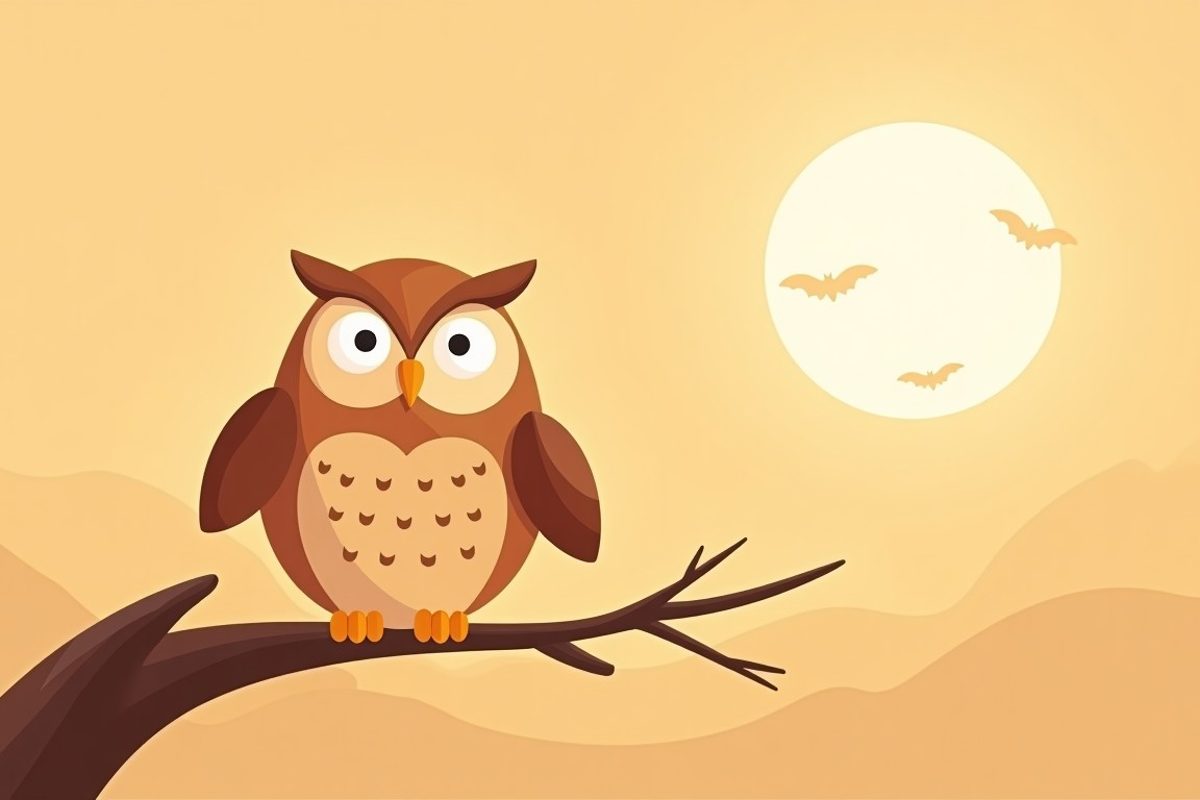
The spiritual meaning of an owl is the ability to see in the dark: wisdom, intuition, and the courage to face truths that are usually hidden. Because owls are also tied to death and endings in many cultures, an owl sighting is often read as a sign that something is closing so that something new can begin, and as an invitation to trust what you know beneath the surface.
The owl is one of the most debated animal symbols in the world. In one culture it is the companion of the goddess of wisdom; in another, it is a bird you do not want to hear outside your window. This guide walks through both, then covers what the owl suggests for love, grief, and dreams, how to relate to it as a spirit animal, and what to do when one appears.
What Does an Owl Symbolize?
Owl symbolism grows out of the bird's unusual nature.
- Seeing in darkness. Owls are mostly nocturnal and are built for low light. Spiritually, this becomes intuition and insight: the ability to perceive what others miss, especially in confusing or painful times.
- Hearing what is unspoken. Some owls, including the barn owl, have ears set at different heights on their heads, which helps them pinpoint sound. Barn owls can locate prey by hearing alone. The symbolic version is listening closely, including to what people do not say.
- Silence. Many owls fly almost silently thanks to soft, fringed feathers that break up turbulence. This has made them symbols of stillness, discretion, and moving through the world without unnecessary noise.
- Wider perspective. Owls cannot move their eyes in their sockets, so they turn their heads instead, up to around 270 degrees. This is often read as the invitation to look at a situation from every side, including behind you.
- Endings and transitions. Because owls belong to the night, they are associated with the threshold between worlds: between waking and sleeping, life and death, one chapter and the next.
The Owl in Cultural Traditions
No animal symbol shows cultural variation more clearly than the owl. It is worth reading these side by side rather than picking only the comfortable ones.
Ancient Greece: the owl of Athena
The best-known owl in Western culture is the little owl (its scientific name, Athene noctua, honors the connection) that accompanied Athena, goddess of wisdom and strategy. The owl appeared on Athenian silver coins, and the phrase "owls to Athens" became a Greek way of saying something was pointless, like carrying coals to Newcastle. Much of the modern Western link between owls and wisdom comes from this tradition. The philosopher Hegel later used "the owl of Minerva" (Minerva being Athena's Roman counterpart) as a metaphor for wisdom that arrives only at dusk, once events have unfolded.
Ancient Rome
The Romans were much less fond of owls. Writers such as Pliny the Elder described the owl as a bird of ill omen, especially when seen in a city or during the day, and owl sightings were reported among the portents preceding the deaths of several notable Romans. This darker reading carried into much of medieval European folklore.
Native American traditions
It is common to see the owl described online as a universal Native American symbol of wisdom. That is not accurate. For many Native nations, including the Apache and the Navajo (Diné), the owl is associated with death, the spirits of the dead, or bad news, and it is treated with caution and respect rather than celebrated. In some Cherokee traditions, owls are connected with people who have spiritual power, both healers and those who misuse it. Other nations hold different views; among the Hopi, for example, the burrowing owl is linked in some accounts to the underworld and to the growth of crops. The respectful approach is to remember that each nation has its own understanding and to avoid treating the owl as a generic good-luck charm in a Native context.
Celtic tradition
In the Welsh Mabinogion, the medieval collection of tales, the magician Gwydion creates a woman named Blodeuwedd out of flowers to be the wife of Lleu. When she betrays Lleu and plots his death, Gwydion punishes her by turning her into an owl, condemned to hide from daylight and to be shunned by other birds. Her name is often linked to "flower face," a reference to the owl's round facial disk. In this story the owl is tied to betrayal, consequence, and the night. In Irish and Scottish folklore, owls are more often associated with the Otherworld and with omens. The idea of the owl as a gentle Celtic wisdom figure is largely modern.
Japan and the Ainu
In Japan, the owl (fukurou) is widely considered lucky, largely because of wordplay: the name can be written to suggest "no hardship" (fu-kurou) or "luck comes" (fuku-kuru). Owl charms are common gifts for protection and good fortune. Among the Ainu, the Indigenous people of northern Japan, Blakiston's fish owl was revered as Kotan-kor-kamuy, the god who protects the village.
India
In Hindu tradition, the owl (uluka) is the vehicle of Lakshmi, goddess of wealth and prosperity, and owls are sometimes considered auspicious around Diwali. At the same time, in everyday Hindi, calling someone an owl (ullu) means calling them a fool. Both meanings live side by side.
The Owl in Love and Relationships
The owl's message in love is honesty and depth rather than sweetness.
- If you are in a relationship: an owl can be a prompt to look at what is happening beneath the surface. Is there something you have both been avoiding? The owl does not create problems; it reveals what is already there so it can be addressed.
- If you suspect you are not being told the truth: owls are linked to seeing through deception. That said, a sighting is not evidence. Use it as a reason to pay attention and have a direct conversation, not as proof of anything.
- If you are single: the owl encourages wisdom in choosing. Listen to how people act over time, not just to what they say early on.
- If a relationship is ending: the owl's association with endings can be read as permission to let it close with dignity. Its night is followed by morning.
If you find the owl stirring up insecurity in a relationship, some honest reflection can help separate intuition from old fear. Shadow work prompts are a useful tool here.
Owls, Death, and Grief
Because of the owl's long association with death in Roman, European, and many Native traditions, some people feel alarmed when they hear one at night. It helps to put that fear in context. Hearing or seeing an owl does not mean someone is going to die. Owls are common, mostly nocturnal birds that call to communicate with mates and defend territory, especially in late autumn and winter.
Spiritually, the owl's link to death is better understood as a link to transition. It sits at the boundary between one state and another. For people who are grieving, an owl can feel like a presence that understands the dark season they are in. Some take it as a sign that a loved one has crossed safely; others simply find its stillness companionable on sleepless nights.
If you have been noticing other signs after a loss, such as feathers or a cardinal appearing at meaningful moments, you may find that the owl belongs to the same quiet conversation with your grief. The owl's particular message tends to be: you can see your way through this darkness, even if slowly.
Dreaming of an Owl
Owls are classic dream symbols because both owls and dreams belong to the night. Start with your own feelings about owls, then consider these interpretations:
- An owl watching you: your intuition is trying to get your attention, or you sense you are being observed or evaluated.
- An owl hooting: a message or piece of news; pay attention to conversations in the coming days.
- An owl in flight: clarity arriving, or a wish to rise above a confusing situation.
- A white owl: often read as a sign of transformation, protection, or spiritual insight.
- An owl attacking: a truth you have been avoiding that is now demanding attention.
- A dead owl: the end of a phase, or intuition you have stopped listening to.
For a deeper look at how your mind uses images like these, see the language of dreams.
The Owl as a Totem or Spirit Animal
If you feel a deep connection to owls, you might think of the owl as your spirit animal. For background on the concept and how to approach it respectfully, read what is your spirit animal.
People who resonate with the owl often recognize these qualities:
- They are observant and quiet, and they tend to listen more than they speak.
- They have strong intuition and are hard to deceive.
- They are comfortable with solitude and often do their best thinking at night.
- Others come to them for advice, especially in hard times.
The shadow side is withdrawal. Owl people can retreat too far into observation and analysis, keeping others at a distance. The owl's lesson includes knowing when to come out of the tree and speak.
The owl's closest counterpart is the hawk. Both are birds of prey with remarkable senses, but the hawk represents daylight vision and decisive action, while the owl represents night vision, patience, and hidden knowledge. Many people find they need both at different times.
What to Do When You See or Hear an Owl
A sign is most valuable when it leads somewhere. Here is a simple practice for the moment an owl appears.
- Be still. If you see or hear an owl, stop and listen. Owls reward patience. Let your breathing slow.
- Ask what is hidden. Ask yourself: "What truth am I avoiding right now?" Do not force an answer; let the question sit overnight if needed.
- Listen to what is unsaid. Over the next day, pay close attention to the gap between what people say and what they do, including yourself.
- Name what is ending. Identify one thing, a habit, a role, a relationship pattern, that has run its course. You do not have to act immediately; naming it is enough to begin.
- Write before sleep. The owl belongs to the night. Before bed, jot down one question you want clarity on, and notice what comes to mind on waking.
An owl journal practice
Try this for seven nights. Before sleep, answer three questions:
- What did I notice today that others seemed to miss?
- What did my intuition tell me, and did I listen?
- What am I ready to stop carrying?
In the morning, write down any dream fragments or first thoughts. Over a week, patterns often appear that are hard to see in daylight.
A night-sit meditation
If it is safe and comfortable to do so, sit outside or by an open window after dark for ten minutes. Close your eyes and simply listen. Notice the farthest sound you can hear, then the nearest. This mirrors the owl's way of knowing the world and is a simple, grounding practice for anyone who feels overwhelmed. If you are new to sitting still, meditation for beginners covers the basics.
A Grounded Note on Signs
Owls live in cities, suburbs, and countryside on nearly every continent, so hearing one is not rare. What makes an owl meaningful is the timing and the questions it raises in you. Treat it as an invitation to look more closely, not as a forecast of good or bad fortune. Whether your background sees the owl as the companion of wisdom or as a messenger from the other side, the most useful response is the same: get quiet, look carefully, and trust what you find.
Frequently Asked Questions
What does it mean when you see an owl?
Seeing an owl is usually read as a call to trust your intuition and look beneath the surface of a situation. It can also signal that a phase of life is ending so that a new one can begin.
Is seeing an owl a bad omen?
It depends on the culture. Ancient Romans and many Native American nations associated owls with death or bad news, while ancient Greeks linked them to wisdom and Japanese tradition considers them lucky. An owl sighting does not predict harm; it is better read as a sign of transition.
What does it mean when you hear an owl at night?
Hearing an owl hoot is often interpreted as a message to pay attention to your intuition or to news that is coming. Practically, owls call to communicate with mates and defend territory, especially in late autumn and winter.
What does an owl mean after someone dies?
Because owls are linked to the threshold between worlds, many people see one after a loss as a sign that a loved one has crossed safely. It can also be a companion symbol for grief, suggesting you can see your way through a dark season.
What does a white owl mean spiritually?
A white owl is commonly read as a sign of transformation, protection, and spiritual insight. Because white owls are rarely seen, their appearance often feels especially significant to people.
What is the owl spirit animal?
The owl spirit animal represents intuition, wisdom, observation, and comfort with solitude. Its main lesson is to share what you see rather than withdrawing too far into silence.