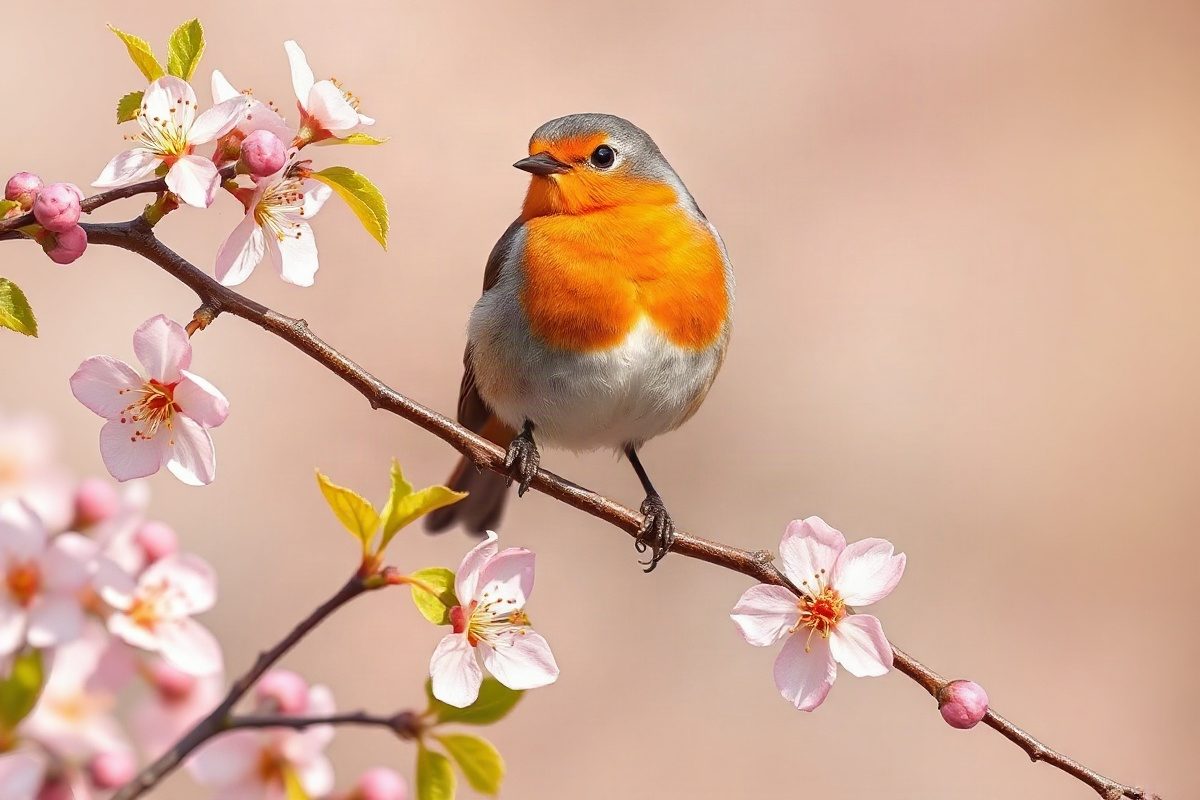
The spiritual meaning of a robin is most often renewal, hope, and comfort: a robin is widely read as a sign of new beginnings and, for many grieving people, as a reminder that a loved one is still near. The popular saying "when robins appear, loved ones are near" captures the feeling, while older European folklore links the bird to Christmas, to compassion, and to the turning of the seasons.
Before going further, it helps to know that "robin" means two different birds depending on where you live, and their symbolism overlaps but is not identical. This guide covers both, along with what a robin can mean in love, in grief, in dreams, and as a spirit animal, and what you can do when one shows up for you.
Two Robins, Two Sets of Traditions
The European robin is a small, round bird with an orange-red face and breast. It is famous in Britain and Ireland for singing through the winter and for following gardeners as they dig, waiting for worms. It was chosen as Britain's favourite bird in a widely publicized 2015 public vote.
The American robin is a larger bird, actually a thrush, with a brick-red breast. English-speaking settlers named it after the robin they knew from home because of the red breast. In much of North America it is seen as the classic sign of spring, singing at dawn and pulling worms from freshly thawed lawns, even though many robins stay through the winter in sheltered areas.
So when people talk about robin symbolism, British and Irish traditions tend to focus on winter, Christmas, and the home, while North American readings lean toward spring, renewal, and fresh starts. Both share a strong association with comfort and with those we have lost.
What Does a Robin Symbolize Spiritually?
- Renewal and new beginnings. Especially in North America, the robin announces the end of winter. Seeing one is read as a sign that a hard season in your life is turning.
- Hope through dark times. The European robin sings in the coldest months, sometimes even at night near streetlights. That persistent song has made it a symbol of hope that does not wait for good conditions.
- Comfort and the presence of loved ones. This is the meaning most people search for, and it gets its own section below.
- Home, family, and nurturing. Robins are attentive parents, and the American robin's blue eggs gave us the phrase "robin's egg blue." Nesting robins often symbolize family and the care of new life.
- Courage and boundaries. Robins look gentle but defend their territory fiercely. They remind you that kindness and firm boundaries can live together.
Robins in Folklore and Religious Tradition
The red breast legends
Christian folklore in Britain and Europe tells several stories about how the robin got its red breast. In one, a small brown bird flew to Jesus on the cross and tried to pull a thorn from his crown, and a drop of blood stained its breast forever. In another, set on the night of the Nativity, a robin fanned the dying fire in the stable to keep the infant Jesus warm, and the flames scorched its chest red. These are legends rather than scripture, but they explain why the robin is so closely tied to compassion and self-sacrifice in Christian imagination.
Christmas and the Victorian postmen
The robin became a fixture on British Christmas cards in the Victorian era. A frequently told explanation is that postmen at the time wore red coats and were nicknamed "robins," so cards often showed robins delivering the post. Whatever the full story, the bird became firmly tied to winter festivals, greetings, and messages arriving from afar, which feeds into its modern role as a messenger.
Superstitions about robins
British and Irish folklore treated the robin with great respect. Killing a robin or harming its nest was considered deeply unlucky. In some older superstitions, a robin flying into the house or tapping at a window was said to foretell a death in the family. Today most people read the same event very differently, as a visit or a comfort rather than a warning, and there is no reason to treat a robin indoors as a bad omen. It is usually just a curious bird that has lost its way.
The robin also appears in old ballads and nursery rhymes. In the story of the "Babes in the Wood," robins cover the lost children with leaves after they die, an image of tenderness toward the dead that may be one root of the bird's link with grief. The rhyme "Who Killed Cock Robin?" describes the whole community of birds mourning the robin, another sign of how loved the bird was.
Native American traditions
Many Indigenous nations of North America have stories involving the robin, but they differ from nation to nation and are best learned from those communities directly. Be cautious with websites that assign one "Native American meaning" to the robin without naming a people or a source.
Robins and Grief: "When Robins Appear, Loved Ones Are Near"
For many people, the robin's most important meaning has nothing to do with folklore books. It is the bird that showed up in the garden the week after a funeral, that sat on the fence at the cemetery, that returned every morning to the same branch outside a widow's kitchen window. The saying "when robins appear, loved ones are near" is modern, and its exact origin is unclear, but it has spread because it puts words to an experience that many grieving people share.
Why the robin? Part of the answer is behavior. European robins are unusually bold around people. They come close, hop near your feet, and watch you with apparent interest. That closeness feels personal, especially when you are raw with loss. Part of it is history, from the tender robins in old ballads to the bird's place on Christmas cards, a season when absence is felt most sharply.
Whether a robin is literally a message from someone who has died is not something anyone can prove. What can be said is that these moments are real comforts, and dismissing them helps no one. Grief researchers have described "continuing bonds," the idea that healthy mourning often involves keeping a connection to the person rather than cutting it off (Klass, Silverman & Nickman, 1996). A robin can become one of those bonds: a moment each day to remember, speak to, or simply feel close to the person you miss.
If you notice robins after a loss, you might also relate to other signs people report, such as seeing a cardinal, a bird with a very similar meaning in North America, or finding feathers in unexpected places.
A small remembrance ritual
- When the robin appears, pause and say the person's name, aloud or silently.
- Tell them one thing: something you wish they could see, something you are grateful for, or simply that you miss them.
- Watch the robin until it leaves. Let it go without trying to hold the moment.
- Later, write one line in a notebook about the visit. Over time, this becomes a record of your connection and of how your grief is changing.
Some people put out food for robins, such as mealworms, as a living memorial. It gives the grief somewhere to go and brings the birds back regularly.
The Robin and Love
Robin pairs are associated with devotion and shared work: building nests, feeding young, and starting again the next season. In relationship terms, the robin is usually read as:
- If you are single: a sign that a fresh season is opening. It favors letting go of an old disappointment so something new can begin.
- If you are in a relationship: a reminder that love is built in daily care, the equivalent of carrying twigs and worms. It can also point to building a home or starting a family.
- If a relationship has ended: the robin's link with spring suggests that this winter will not last forever.
The robin's territorial side has a lesson for love as well. Warmth and openness work best with clear boundaries. If you tend to give until you are empty, the robin models a healthier balance.
Dreaming of a Robin
As with any dream, the personal associations matter most. Common readings include:
- A singing robin: good news, hope, or a part of you that is ready to express itself.
- A robin's nest or blue eggs: new projects, pregnancy, or the desire to nurture something.
- A robin in your house: comfort, a visit from memory, or a wish for warmth at home.
- A robin after someone has died: many people experience this as a comforting visitation dream. Let it be what it is to you.
- An injured or dead robin: often linked to fear of losing hope or a sense that something tender in you needs care. It is a prompt, not a prediction.
The Robin as a Spirit Animal
People drawn to the robin as a spirit animal often describe themselves as resilient optimists: they keep going in hard seasons and help others do the same. If you are exploring this idea for the first time, what is your spirit animal explains how the concept works.
The robin tends to teach:
- Sing before spring arrives. Hope is not a response to good conditions; it is a practice you keep while waiting for them.
- Start again each season. Robins rebuild nests and raise new broods. Setbacks do not end the story.
- Stay close to the ground. Robins find their food by paying attention to what is right in front of them. Small, present actions often matter more than grand plans.
- Defend what matters. Gentleness does not mean having no limits.
The robin is part of a wider family of messenger birds people feel drawn to. If transformation rather than renewal is your theme, the spiritual meaning of butterflies may resonate as well, and the hummingbird carries a related message about joy and lightness.
What to Do When You See a Robin
A sign is most helpful when it leads to reflection or action. Try this the next time a robin catches your eye.
- Stop and watch. Notice what it is doing: singing, feeding, guarding, nesting. Its behavior can color the meaning.
- Notice where you are in your own seasons. Are you in a winter, waiting, or in a spring, starting something new?
- Name one fresh start. Pick one area where you are ready to begin again, however small.
- Honor someone if you need to. If you are grieving, use the remembrance ritual above.
- Write it down. Keep a simple log of robin sightings and what you were thinking. Patterns tend to emerge over a few weeks.
Journal prompts
- What winter in my life is ending, and what am I ready to plant?
- Who would I most like to feel close to right now, and what would I tell them?
- Where am I singing anyway, and where have I gone quiet?
- What boundary would protect the things I am nurturing?
An affirmation
"Even in winter I keep my song. New seasons always come, and I am never as alone as I feel."
A Grounded Perspective
Robins are common garden birds, and they are naturally drawn to people who dig, mow, or put out food. After a loss, you may also be spending more time looking out of windows or sitting quietly outside, which makes sightings more likely and more noticeable. Your attention, once tuned to a symbol, finds it more often. None of this cancels the meaning you feel. It simply locates the power of the sign where it can help most: in how you choose to respond. A robin cannot tell you what the future holds, but it can remind you, every time, to keep hoping and to remember with love.
Frequently Asked Questions
What does it mean when a robin visits you?
A robin visit is most often read as a sign of hope, renewal, and comfort. Many people take it as a reminder that a hard season is ending, and for those who are grieving, as a sign that a loved one is still close.
Is a robin a sign from someone who has died?
Many grieving people feel that a robin is a visit or message from a loved one, and the saying "when robins appear, loved ones are near" reflects this. No one can prove who a sign comes from, but the comfort it brings is real and worth honoring.
Is it bad luck if a robin comes into your house?
Some old British superstitions linked a robin indoors to a death in the family. Most people today read it as a comforting visit rather than a warning, and it is usually just a curious bird that needs help finding its way out.
What is the difference between the European and American robin?
The European robin is a small orange-breasted bird tied to winter and Christmas in British folklore. The American robin is a larger thrush named after it by settlers and is seen as a sign of spring and renewal.
What does a robin symbolize in Christianity?
Christian legends say the robin got its red breast from Christ's blood while pulling a thorn from his crown, or from fanning the fire to warm the infant Jesus. These stories tie the robin to compassion and sacrifice.
What does it mean to dream of a robin?
A robin dream is often read as hope, good news, or a new beginning. Nests and blue eggs can point to something new you are nurturing, while a robin after a loss is often experienced as a comforting visit.