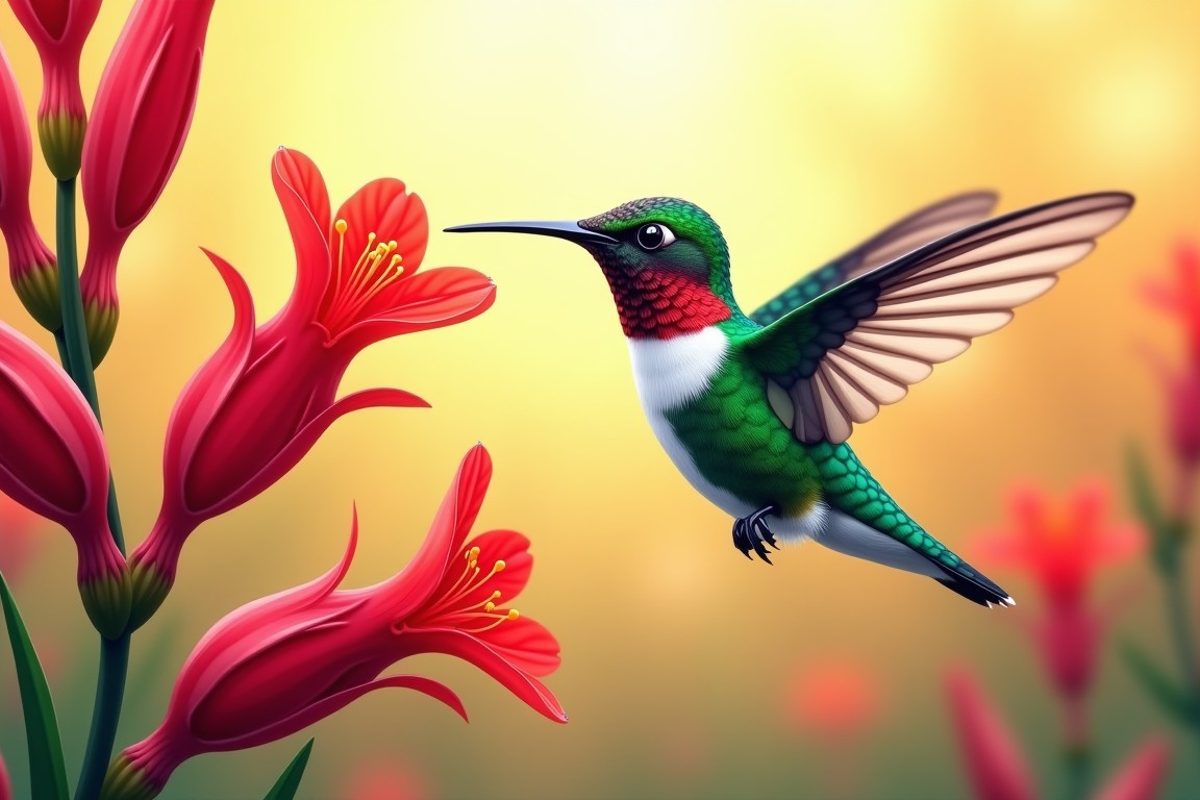
The spiritual meaning of a hummingbird is joy that takes effort: a tiny bird that burns enormous energy to stay in the air, yet spends its life moving from flower to flower in search of sweetness. When one appears, it is usually read as a reminder to savor the present, to keep going with lightness, and to notice the good things that are already within reach.
Below you will find what the hummingbird symbolizes, how cultures across the Americas have understood it, what it suggests for love and grief, how to read it in dreams, what it means as a spirit animal, and a simple practice for when one shows up in your life.
What Does a Hummingbird Symbolize?
Hummingbirds live only in the Americas, which matters: almost all of the traditional symbolism comes from Indigenous cultures of North, Central, and South America and the Caribbean. Much of it is rooted in what makes these birds remarkable.
- Joy and sweetness. Hummingbirds feed on nectar and visit hundreds of flowers a day. They have become a near-universal image of seeking out what is sweet in life and enjoying it fully.
- Resilience out of proportion to size. The ruby-throated hummingbird, which weighs only a few grams, migrates across the Gulf of Mexico. Its smallness makes its endurance all the more striking, which is why hummingbirds are linked to courage and persistence.
- Presence. They can hover in place and are the only birds capable of sustained backward flight. Spiritually, hovering is read as the ability to stay fully in one moment, and flying backward as the freedom to revisit the past without getting stuck there.
- Energy and its limits. Hummingbirds have the highest metabolism of any bird. To survive cold nights, many enter torpor, a deep rest state where their body temperature and heart rate drop dramatically. The lesson people draw is a balanced one: vibrant energy depends on real rest.
- Love and attraction. The bond between hummingbird and flower is one of pollination as well as feeding. This exchange is the root of many romantic legends.
The Hummingbird in Cultural Traditions
Because "Native American" covers hundreds of distinct nations, it is more accurate to look at specific peoples and the stories they actually tell.
The Aztecs (Mexica)
For the Aztecs, the hummingbird was a warrior. Their patron god of the sun and war was Huitzilopochtli, a name usually translated as "hummingbird of the south" or "left-handed hummingbird." In Aztec belief, warriors who died in battle accompanied the sun for four years and then returned to earth as hummingbirds or butterflies, drinking nectar among the flowers. The hummingbird was therefore both fierce and tender: a symbol of courage and of the souls of the honored dead.
This is less surprising than it sounds. Hummingbirds are famously territorial and will chase much larger birds away from their feeding spots.
The Taino of the Caribbean
The Taino, the Indigenous people of the Greater Antilles, regarded the hummingbird as a symbol of rebirth and as a small but brave guardian. A well-known Taino love story tells of two young people from rival groups, often named Alida and Taroo in retellings, who were forbidden to be together. One was transformed into a red flower and the other into a hummingbird so that they could meet in secret forever. The story is part of why the hummingbird is so strongly tied to love in the Caribbean, and Trinidad and Tobago is still often called "the land of the hummingbird."
The Hopi and Zuni
In the arid Southwest, the hummingbird is connected to rain. A Hopi story tells of a time of drought and famine when a hummingbird flew to the god of germination and fertility to plead for the people, and rain returned. Hummingbird imagery appears in Hopi katsina figures and in Zuni ritual, where it is associated with water and the life it brings.
The Cherokee
In a Cherokee story, the tobacco plant was lost to the people, and the elders grew ill without it. Several animals tried and failed to bring it back. The hummingbird, too fast to be caught, succeeded in retrieving it. Here the hummingbird is a healer and a bringer of what is sacred, and its smallness is exactly what makes the mission possible.
The Andes and the Nazca lines
One of the most famous Nazca geoglyphs in southern Peru, created roughly two thousand years ago, depicts a hummingbird with outstretched wings. Its exact meaning is debated by archaeologists, though many link the Nazca lines to water and fertility rituals. In some Andean traditions the hummingbird is a messenger between worlds.
Beyond the Americas
Because hummingbirds are not native to Europe, Asia, or Africa, you will not find them in ancient Celtic, Japanese, or Chinese lore. Claims online about "Celtic hummingbird symbolism" are modern inventions. That does not make modern meanings invalid; it just helps to know where each one comes from.
The Hummingbird in Love and Relationships
Given the Taino legend and the hummingbird's link to flowers, it is no surprise that it is one of the most romantic animal symbols in the Americas.
- If you are in a relationship: the hummingbird invites more sweetness. Small gestures, playfulness, and attention to what makes your partner light up are the nectar that keeps a relationship alive. It can also signal that a relationship needs more rest and less constant effort.
- If you are single: it is often read as encouragement to stay open and to enjoy the process of meeting people rather than treating it as a test. Joy is attractive.
- If you are holding on to the past: the hummingbird can fly backward, but it does not stay there. Revisit the old relationship long enough to learn from it, then turn toward what is in front of you.
The hummingbird is also a reminder that love should not be all scarcity and struggle. If a connection constantly drains you, compare it with the healthy signs you would hope to see in a partner. And if you are actively trying to call in a partner, the approach in how to manifest love pairs well with the hummingbird's message of openness and delight.
Hummingbirds, Death, and Grief
Many people report seeing hummingbirds after a loved one dies, sometimes hovering unusually close or appearing at a significant moment. The Aztec belief that honored souls returned as hummingbirds offers one ancient frame for this experience, and modern grief traditions in the Americas have picked up the image too.
If a hummingbird has felt like a visit, you do not need to argue yourself out of the comfort it gave. You also do not need to treat it as proof. A middle path is to receive it as a reminder of the person's warmth and of the sweetness that still exists in a life that now feels heavy. Some people plant flowers that attract hummingbirds as a living memorial, which turns a passing sign into an ongoing ritual of remembrance.
Other common grief signs follow the same pattern. If you have noticed several, you may find it helpful to read about the spiritual meaning of seeing a cardinal and the spiritual meaning of feathers, both of which are often associated with loved ones who have passed.
Dreaming of a Hummingbird
Dreams use personal symbols, so begin by asking how you feel about hummingbirds in waking life. Then consider these common interpretations:
- A hummingbird hovering in front of you: a message to be present and pay attention to something small but important.
- Feeding at a flower: a period of enjoyment and nourishment, or a reminder to let yourself have it.
- A hummingbird in your hand: something precious and fragile has been entrusted to you, perhaps a new relationship or idea.
- A trapped hummingbird indoors: joy or energy that feels confined, often by obligations or other people's expectations.
- An injured or dead hummingbird: burnout, or a loss of delight that needs attention and rest.
- A hummingbird flying backward: a need to revisit something in your past, briefly, in order to move forward.
The Hummingbird as a Totem or Spirit Animal
If you keep encountering hummingbirds or simply feel a deep affinity with them, you may think of the hummingbird as your spirit animal. The broader concept, along with ways to approach it respectfully, is covered in what is your spirit animal.
People who feel the hummingbird as a guide often recognize these qualities:
- They bring lightness and warmth into a room.
- They are tougher than they look and defend what matters to them.
- They have a quick, curious mind and enjoy variety.
- They are sensitive to beauty, color, and small pleasures.
The shadow side is overextension. Hummingbirds have to eat constantly to sustain their pace, and hummingbird people can run on enthusiasm until they crash. The torpor lesson is central here: deep rest is not a failure of energy but the thing that makes it possible.
Among its sibling symbols, the dragonfly shares the hummingbird's agility and darting flight but leans more toward transformation and clear perception, while the butterfly shares its love of flowers but speaks more of rebirth.
What to Do When You See a Hummingbird
The point of a sign is what it changes. Here is a short practice for the moment a hummingbird catches your eye.
- Stop and watch. Hummingbirds rarely stay long. Give it your full attention for as long as it remains. That brief stillness is the first part of the message.
- Name one sweet thing. Ask: "What is one good thing in my life right now that I have not been enjoying?" Then go and enjoy it today, even for five minutes.
- Check your energy. Ask: "Am I hovering or exhausted?" If the honest answer is exhausted, schedule real rest before you schedule anything else.
- Do one brave small thing. The hummingbird is tiny and fearless. Choose a small action you have been avoiding and do it.
- Say thank you. A short moment of gratitude, out loud or on paper, closes the loop and trains your attention toward sweetness.
A hummingbird journal practice
For one week, write down three small moments of joy each evening: a taste, a conversation, a color, a sound. Keep them specific. This is the hummingbird's way of moving through the world, and research on gratitude journaling, including Emmons and McCullough's 2003 study, suggests that regularly noting good things is linked to improved well-being. If you want structure, these gratitude prompts are a good starting point.
Alongside your list, answer one deeper question each day:
- Where am I spending energy that does not nourish me back?
- What would "lightness" look like in my hardest situation right now?
- When did I last let myself rest without guilt?
Inviting hummingbirds in
If you live in the Americas, you can turn the symbol into a living practice by planting nectar-rich native flowers or putting up a clean feeder (plain sugar water in a ratio of roughly one part sugar to four parts water, never red dye or honey, changed every few days). Watching for them becomes a daily invitation to presence.
A Grounded Note on Signs
In many parts of the Americas, hummingbirds are common in gardens during warm months, so seeing one is not unusual in itself. What gives the encounter meaning is timing, emotion, and the questions it raises. Treat it as a mirror rather than a forecast. A hummingbird cannot promise that a relationship will work out or that grief will lift on a schedule, but it can remind you that sweetness and strength often come in very small packages, and that both are available to you today.
Frequently Asked Questions
What does it mean when a hummingbird visits you?
A hummingbird visit is usually read as a reminder to enjoy the present and to notice the sweetness already in your life. It can also be a nudge toward resilience and lightness during a demanding period.
Is a hummingbird a sign from someone who has died?
Many people experience it that way. The Aztecs believed warriors who died honorably returned as hummingbirds, and modern grief traditions often see them as visits from loved ones. There is no way to prove it, but the comfort can be meaningful.
What does a hummingbird mean in Native American culture?
Meanings vary by nation. The Aztecs linked it to warriors and the sun god Huitzilopochtli, the Hopi and Zuni to rain, the Cherokee to healing through the tobacco story, and the Taino to love and rebirth.
Is seeing a hummingbird good luck?
In most traditions of the Americas the hummingbird is a positive sign associated with joy, love, and good fortune. It is best taken as encouragement rather than as a guarantee of a specific outcome.
What does a hummingbird mean in love?
In love, the hummingbird stands for sweetness, playfulness, and devotion, partly due to the Taino legend of lovers turned into a hummingbird and a flower. It encourages more delight and less struggle in relationships.
What is the hummingbird spirit animal?
As a spirit animal, the hummingbird represents joy, courage, quick thinking, and appreciation of beauty. Its main lesson is balance, since vibrant energy depends on deep and regular rest.