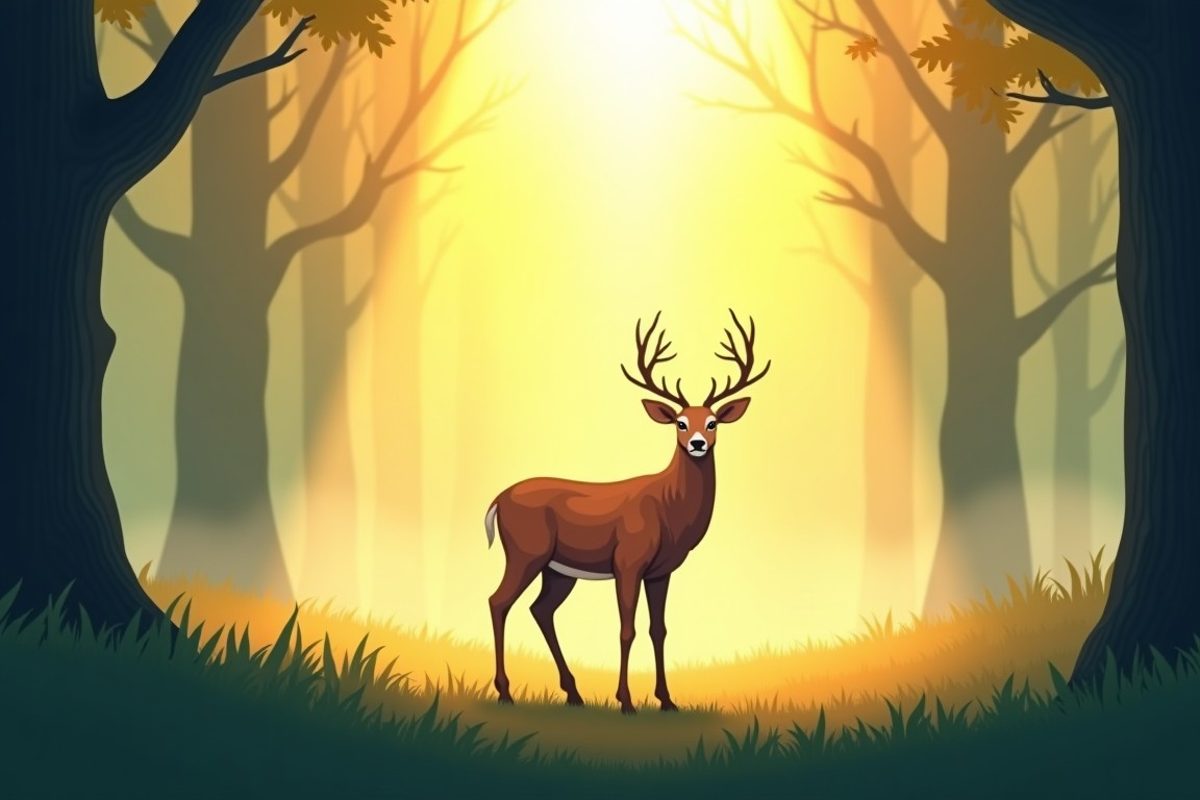
The spiritual meaning of seeing a deer is usually gentleness paired with alertness: a deer invites you to move through a situation softly, trust your instincts, and stay aware without becoming hard. In many traditions the deer is also a sign of renewal, spiritual seeking, and a quiet kind of strength that does not need to win every fight.
Seeing a deer often feels like a small event that stops time. One moment you are driving or walking, and the next you are looking into the eyes of a wild animal that is looking right back. It is easy to see why so many cultures gave the deer sacred meaning. This guide covers what a deer generally symbolizes, what specific traditions say, what a deer might mean in love and grief, how to read deer dreams, and what to do after an encounter.
What Does Seeing a Deer Mean Spiritually?
Deer symbolism draws heavily on the animal's actual nature. Deer are prey animals, so they survive through awareness, not aggression. Their senses are sharp, they freeze when uncertain, and they move with remarkable grace. Male deer of most species grow and shed their antlers every year. Those facts shape the main spiritual themes:
- Gentleness and compassion. The deer is the classic image of softness. Seeing one can be a reminder to treat yourself or someone else more kindly.
- Intuition and sensitivity. Deer notice the smallest sound. Spiritually, they are linked to reading a situation before reacting and trusting subtle signals.
- Renewal and regeneration. Antlers grow back each year, which makes the stag a symbol of cycles, regrowth, and the return of strength after loss.
- Quiet strength. Deer endure harsh winters and predators without fighting their way through everything. They show a strength that comes from patience and awareness.
- Spiritual seeking. In several religious traditions the deer represents the soul's longing for the divine, or a guide that leads a seeker toward something sacred.
Does it matter whether it is a doe, a stag, or a fawn?
People often read them a little differently. A doe tends to point to nurturing, protection, and sensitivity. A stag with antlers adds authority, dignity, and the cycle of growth and release. A fawn is linked to innocence, new beginnings, and vulnerability that needs protecting. A deer that stands and holds your gaze is often read as a call to pause; one that bounds away may point to letting something go or moving on quickly.
Deer in Cultural and Religious Traditions
The deer appears in sacred stories across much of the world. Here is what specific traditions actually say, rather than a blended "ancient wisdom" version.
Buddhism: the Deer Park and the wheel of teaching
The Buddha gave his first sermon after his awakening at the Deer Park in Sarnath, near Varanasi in India. Because of this, two deer are often shown on either side of the Dharma wheel on the roofs of Tibetan Buddhist temples, representing the first listeners of the teaching. The Jataka tales, stories of the Buddha's earlier lives, include the Banyan Deer, a deer king who offers his own life in place of a pregnant doe and moves a human king to stop the hunting. In Buddhism the deer stands for peace, receptivity to truth, and compassion.
Japan: the deer of Nara
In Shinto tradition, the deer of Nara are regarded as messengers of the kami. According to the founding legend of Kasuga Taisha, the deity Takemikazuchi arrived at Nara riding a white deer. Deer have roamed the city freely for centuries and are protected today as a national natural treasure. Here the deer is a sacred messenger and a sign that a place is under divine care.
China: prosperity and long life
In Chinese, the word for deer (lu) sounds like the word for an official's salary or good fortune, so deer appear in art as a wish for prosperity and success. The deer is also commonly shown alongside Shoulao, the god of longevity, and is associated in Daoist lore with long life and the search for the herb of immortality.
Celtic lore: Cernunnos and the white stag
An antlered figure appears on the Gundestrup cauldron and other Celtic-era images. He is usually identified with Cernunnos, a god connected with animals, the wild, and abundance, although much about him remains uncertain because the Celts left few written records. In later Arthurian and Welsh-influenced romance, a white stag or white hart often appears as a creature that cannot be caught, leading knights into adventure and signaling that they are entering a sacred or otherworldly quest. In these stories the deer stands for the call to pursue something beyond ordinary life.
Christianity: the soul's thirst
Psalm 42 opens with the line "As the deer pants for the water brooks, so pants my soul for You, O God." The image of the thirsty deer became a lasting symbol of spiritual longing. Christian legend also tells of Saint Hubert and Saint Eustace, both said to have converted after seeing a stag with a crucifix between its antlers while hunting. Saint Hubert later became a patron saint of hunters, a reminder of the link between respect for animals and spiritual awakening.
Indigenous traditions of the Americas
Many Indigenous nations hold the deer in high regard, and their meanings differ. In Cherokee tradition, there is a story of Awi Usdi, Little Deer, the chief of the deer, who visits hunters who kill without asking pardon and without respect, a teaching about taking only what you need and honoring the life you take. Among the Wixárika (Huichol) people of Mexico, Kauyumari, the Blue Deer, is a central spiritual guide in their ceremonial life. The Yaqui (Yoeme) Deer Dance honors the deer as a sacred being of the flower world. These are distinct traditions belonging to living communities, and they are best appreciated on their own terms rather than merged into one generic "Native American deer meaning."
Spiritual Meaning of a Deer in Love
When a deer appears while you are thinking about love, it is usually read as a call for softness and patience.
- If you are in a relationship: the deer suggests gentler communication. A deer does not charge. It approaches slowly and pays attention. Are you listening to your partner, or bracing for a fight?
- If you are single: the deer can point to opening up gradually. You do not have to force a connection. Let trust build at its own pace, and pay attention to how someone makes you feel, not just how they look on paper.
- If you have been hurt: a deer is a reminder that sensitivity is not weakness. You can stay soft while also being alert to people who are not safe for you. Clear limits are part of this; see how to set boundaries without guilt.
A pair of deer seen together is often taken as a sign of harmony and partnership. A doe with a fawn may point to nurturing, family, or protecting something new and fragile in your relationship.
Seeing a Deer After Someone Dies
Many people describe deer appearing in unusual places after a loss: in the backyard on the morning of a funeral, standing quietly near a grave, or crossing the road at a moment when they were thinking of the person. Because deer are gentle and seem to appear and vanish without a sound, they are a common source of comfort in grief.
You can treat a deer in this moment as a reminder of the person's gentleness or as a sign of peace, without needing to decide whether it is a literal message. Some people say a few words of greeting. Others note the date and keep a small record of such moments. Birds such as the robin carry similar associations in Western grief lore. What matters most is what the moment opens up in you: memory, gratitude, or permission to grieve.
Dreaming of a Deer
Dream images draw on your own associations, so take these as starting points rather than fixed answers:
- A calm deer watching you: a call to trust your intuition or approach a waking situation gently.
- A deer running away: something you want feels out of reach, or you are avoiding a situation instead of facing it.
- A white deer: often read as a spiritual call, purity of intention, or a rare opportunity. This echoes the white stag of Celtic-influenced legend.
- A stag with large antlers: confidence, authority, or a period of personal growth.
- A fawn: new beginnings, innocence, or a part of you that needs care.
- An injured or dead deer: vulnerability that has been hurt, or gentleness you feel you have lost. It can also mark the end of a naive phase.
- Hunting a deer: chasing a goal too aggressively, or a conflict between ambition and compassion.
Record the dream, the setting, and above all the feeling. If the feeling was peace, the deer was likely reassurance. If it was fear or sadness, it may point to vulnerability you have not acknowledged.
The Deer as a Spirit Animal
If deer keep appearing in your life or you feel a strong pull toward them, people who work with animal symbolism would say the deer is a guide for:
- Sensitivity as a strength. Deer people often pick up on mood and tension quickly. This can be draining without good self-care, but it is also a gift for understanding others.
- Intuition. The deer trusts its senses. If you tend to override your gut feelings, the deer is a reminder to listen; how to trust your inner voice offers practical exercises.
- Gentle leadership. The stag leads by presence rather than force.
- Renewal. Like antlers, your strength can return after a hard season.
The shadow side of deer energy includes freezing under pressure, avoiding conflict until it grows, and absorbing other people's moods. Working with the deer means learning when to be still and when to move. The term "spirit animal" comes from specific Indigenous practices, so many people use phrases like animal guide for personal reflection. The spirit animal guide explains this and offers ways to explore which animals you resonate with.
The deer pairs naturally with other animal signs. Where the deer teaches gentle awareness, the crow teaches honest observation and the frog teaches renewal through change; seeing them in the same season can be read as a call to soften while you transform.
What to Do When You See a Deer
Here is a short practice for the next time a deer crosses your path:
- Be still. If it is safe, stop moving and simply watch. Notice your breathing. A deer encounter is one of the easiest natural invitations to be fully present.
- Notice the details. Doe, stag, or fawn? Alone or in a group? Calm, alert, or fleeing? Where were you going and what were you thinking about?
- Ask where you need gentleness. Is there a situation where you have been forcing things? Is there someone, including yourself, who needs more patience from you?
- Ask what your instincts are saying. The deer trusts its senses. What have you been noticing but explaining away?
- Write it down. Note the date, place, and your reflections. Patterns become clearer over several weeks.
A deer reflection practice
For one week, take five minutes each evening to answer:
- Where did I respond with force today when gentleness would have worked better?
- What did my body or intuition notice before my mind did?
- What is regrowing in my life, the way antlers return each year?
You might also spend a little time somewhere deer live, walking slowly and quietly. Moving like a deer, softly and attentively, is a simple form of walking meditation.
A Practical Note on Deer Encounters
Deer are most active around dawn and dusk, and in many areas they are very common, especially near suburbs and roads. If you see one while driving, slow down, since others are often nearby. Do not approach or feed wild deer. Keeping a respectful distance is itself part of honoring the encounter.
Seeing a deer does not guarantee luck or predict a particular event. What it can do is interrupt a hurried day and remind you of qualities that are easy to forget: gentleness, awareness, and a strength that grows back. That reminder is valuable whether you read it as a sign or simply as a beautiful moment.
Frequently Asked Questions
What does it mean when a deer crosses your path?
A deer crossing your path is commonly read as a call to slow down, be gentle, and trust your intuition. Many people take it as a sign to approach a current situation with patience rather than force. Practically, it is also a reminder to slow down if you are driving, since deer often travel in groups.
Is seeing a deer good luck?
In many traditions the deer is a positive sign linked to peace, prosperity, and renewal. In Chinese symbolism the word for deer sounds like the word for good fortune, and in Japan the deer of Nara are considered sacred messengers. It is best seen as an encouraging reminder rather than a guarantee of luck.
What does it mean to see a deer after someone dies?
Many people feel a deer appearing after a loss is a sign of peace or a reminder of the person's gentleness. You can treat the moment as an invitation to remember and grieve without needing to prove it is a literal message. Writing down such moments can be a comforting part of mourning.
What does a white deer symbolize?
A white deer or white stag is often seen as a rare spiritual sign. In Celtic-influenced Arthurian legend, the white stag leads knights into quests and the otherworld, so it is linked to a call toward something sacred or a major change. Some white deer are albino or leucistic, which is part of why they feel so striking.
What does it mean when a deer stares at you?
A deer holding your gaze is usually read as an invitation to pause and become fully present. Spiritually it suggests paying attention to your instincts and to the situation in front of you. In practical terms, deer often freeze and watch when deciding whether something is a threat.
What does dreaming of a deer mean?
A deer in a dream often reflects gentleness, intuition, or vulnerability. A calm deer can be reassurance, a fleeing deer can point to something out of reach or avoided, and a fawn may represent a new beginning. The feeling you had in the dream is the most reliable clue.