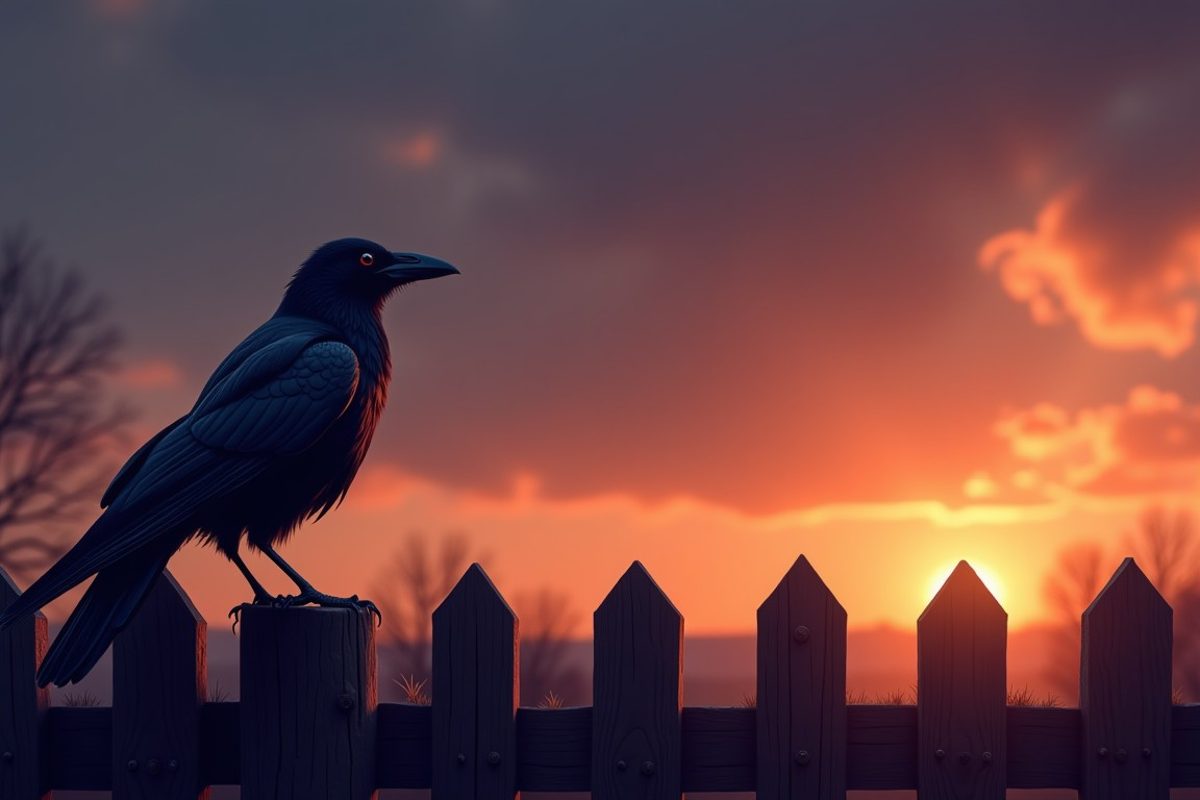
The spiritual meaning of crows centers on messages, memory, and change: crows are widely read as go-betweens linking the everyday world with the unseen, and their appearance often marks a moment to pay attention, speak honestly, and let something old end. They are not, in most traditions, simple omens of death. That reputation is only one thread in a much richer story.
Few birds have collected as many meanings as the crow. It has been a guide to emperors, a companion of war goddesses, a carrier of food to the ancestors, and the clever hero of fables. This guide covers what crows symbolize in general, what specific cultures actually say about them, and what a crow might mean for love, grief, dreams, and your own inner life. It ends with a simple practice for the next time one lands near you.
What Does a Crow Mean Spiritually?
Most interpretations of crow symbolism come back to a handful of themes:
- Messages and mediation. Crows move freely between fields, rooftops, forests, and cemeteries. That ease of movement made them natural symbols of a messenger who carries word between worlds.
- Intelligence and adaptability. Crows solve problems, use tools, and thrive almost anywhere humans live. Spiritually, they stand for resourcefulness and the ability to make use of what is in front of you.
- Memory and ancestors. In several traditions, crows are connected with the dead, not as threats but as links to people who came before.
- Endings that clear the way. Crows are scavengers. They clean up what is finished. Read symbolically, this is about letting go of what has died so something new can grow.
- Truth-telling. A crow's call is loud and hard to ignore. Many people take it as a prompt to say what needs saying, or to stop ignoring something they already know.
It helps to remember what the real bird is like. Crows are among the most studied animals in cognitive science. In a well-known study led by John Marzluff at the University of Washington, researchers wore a particular mask while trapping and banding crows; years later, crows that had never been trapped still scolded people wearing that mask, which suggests crows remember faces and pass that knowledge to others. Later work by Kaeli Swift and Marzluff (2015) found that crows gather noisily around a dead crow, behavior that appears to help them learn about danger. These findings do not prove anything spiritual, but they explain why so many cultures saw crows as watchful, intelligent, and connected to death and memory.
Crows vs. ravens
Crows and ravens are both corvids, and many myths blur them together. Ravens are larger, with wedge-shaped tails, deeper croaking calls, and a tendency to travel in pairs rather than large flocks. When a tradition specifically names the raven, as Norse and many Pacific Northwest stories do, it is worth keeping that distinction, because the meanings are related but not identical.
Crows in Cultural and Religious Traditions
Generalizing about what "Native Americans" or "ancient people" believed about crows leads to a lot of confusion online. Here is what specific traditions actually say.
Japan: Yatagarasu, the guiding crow
In Japanese mythology, Yatagarasu is a three-legged crow sent from heaven to guide the legendary Emperor Jimmu through the mountains of Kumano on his way to Yamato. The crow is still honored at the Kumano shrines, and its image appears on the emblem of the Japan Football Association. Here the crow is a guide sent by the divine, a sign that you are being shown the way through difficult ground.
China: the crow in the sun
Chinese mythology describes a three-legged crow (often called the sanzuwu) living in the sun. One well-known myth tells of ten suns, each carried by a crow, rising together and scorching the earth until the archer Hou Yi shot down nine of them. The crow here is tied to solar power, cosmic order, and the need for balance.
Hinduism: crows and the ancestors
In Hindu practice, crows are closely linked to departed ancestors. During Pitru Paksha, the fortnight dedicated to honoring ancestors, and at shraddha rites, families often set out rice balls (pinda) or food for crows. If the crows eat, many take it as a sign that the offering has been received. The crow is also known as the vahana (vehicle) of Shani, the deity associated with the planet Saturn, karma, and discipline. In this setting, seeing a crow can feel like a reminder of duty to family and to the consequences of your actions.
Celtic and Irish lore: the Morrígan
In Irish mythology, the Morrígan is a goddess of fate, war, and sovereignty who is often described as appearing in the form of a crow or raven. In the Ulster Cycle she lands on the shoulder of the dying hero Cú Chulainn as a crow. Badb, closely associated with her, is sometimes called Badb Catha, "battle crow." Here crows stand for prophecy, fate, and the thin boundary between life and death.
Norse mythology: Odin's ravens
Odin, chief of the Norse gods, is accompanied by two ravens, Huginn and Muninn, usually translated as "thought" and "memory" (or "mind"). Each day they fly across the world and return to tell him what they have seen. Strictly speaking these are ravens, but the image shaped how many people in Europe came to see all black corvids: as carriers of knowledge and memory.
Pacific Northwest: Raven as creator and trickster
Among Pacific Northwest Coast peoples such as the Haida and Tlingit, Raven is a central figure in many stories, a creator and trickster who, in a widely told story, releases the sun, moon, and stars from the box where they were hidden. Again, this is Raven rather than Crow, and these stories belong to specific nations with their own protocols for telling them. They are best read as their own tradition, not folded into a generic "Native American crow meaning."
Greek fable and European folklore
Aesop's fable "The Crow and the Pitcher," in which a thirsty crow drops pebbles into a jug until the water rises, has made the crow a symbol of patient ingenuity for more than two thousand years. Interestingly, modern experiments have shown that some corvids can solve versions of this exact puzzle. In parts of Britain and Europe, crows and ravens were also seen as omens, and counting rhymes about "one for sorrow" exist for both crows and magpies, though the magpie version is the more common one today.
The Crow and Death: Is It a Bad Omen?
Because crows gather where something has died, they were long associated with battlefields, gallows, and graveyards. That history fed the idea that a crow is a death omen. In practice, very few living traditions treat a single crow as a prediction that someone will die.
A more useful way to read the connection is symbolic. Crows point to transitions: the end of a phase, a belief that no longer fits, a relationship that has run its course. They clean up after endings. If a crow catches your attention during a period of change, the message is often closer to "let this finish properly" than "something terrible is coming." If you are drawn to dark-feathered or night-linked symbols in general, the spiritual meaning of owls and the folklore around a black cat crossing your path show the same pattern: animals once feared as omens that many traditions also saw as guardians.
Crows and Grief: Signs From a Loved One
Many people report noticing crows after someone close to them dies: a single crow on the fence each morning, a crow that seems to watch them at the graveside. Given the Hindu link between crows and ancestors, and the Celtic link between crows and the threshold of death, it is not surprising that the bird feels meaningful in grief.
If a crow brings someone to mind, you do not need to decide whether it is "really" them. You can treat the moment as an invitation to remember. Some people speak to the person quietly, some leave a small offering of unsalted nuts or seeds, and some simply note the date and what they were feeling. Crows are known to recognize people who feed them, so a crow that keeps returning may also be responding to you, which can be a comforting relationship in its own right. Other birds carry similar associations; the cardinal and the robin are especially common in Western grief lore, and many people treat a feather found on the path the same way.
Spiritual Meaning of Crows in Love
Crows are not a classic love symbol, but their behavior offers a few useful reflections. American crows often live in extended family groups, and pairs typically stay together across many breeding seasons, with older offspring sometimes helping raise younger siblings. A crow appearing when you are thinking about a relationship may point to:
- Loyalty and long-term partnership. Is this connection built to last, with real cooperation, or is it held together by intensity alone?
- Honest communication. Crows are loud. Is there something you have been unwilling to say to a partner?
- Endings. Sometimes the crow's link with change points to a relationship that has already ended in every way except officially.
No bird can tell you whether to stay with someone. What it can do is break your usual train of thought long enough for you to notice what you already feel.
Dreaming of Crows
Dreams use the images we already carry, so a crow in a dream tends to reflect your own associations as much as any fixed meaning. Common dream scenarios and how people often read them:
- A single crow watching you: awareness of something you have been avoiding, or a sense of being observed or judged.
- A flock of crows: group pressure, gossip, or a situation that feels noisy and overwhelming.
- A crow speaking: a message from your own intuition. Pay attention to the words if you remember them.
- A crow attacking: an unacknowledged fear, guilt, or criticism that is getting louder because it has been ignored.
- A dead crow: often read as the end of a difficult period, or as a fear of change that has finally passed.
- Feeding a crow: making peace with something dark or difficult, or honoring an ancestor.
Write the dream down as soon as you wake, including how you felt. The emotion is usually a better guide than the image. For more on reading dream symbols, see the language of dreams.
The Crow as a Spirit Animal
If you feel a lasting connection with crows, people who work with animal symbolism would describe the crow as a guide for:
- Seeing patterns others miss. Crow people are often observant, strategic, and quick to notice when something is off.
- Comfort with the shadow side. The crow does not look away from death or decay. It can support honest work with the parts of yourself you would prefer not to see, which pairs well with shadow work prompts.
- Adaptability. Crows thrive in cities, farms, and forests. They are a reminder that you can adjust without losing yourself.
- Community. Crows depend on family and flock. A crow guide may be asking whether you are trying to do everything alone.
The challenge side of the crow is worth naming too: mischief, distrust, and a tendency to hoard or overthink. A respectful note: the phrase "spirit animal" comes from specific Indigenous spiritual practices, and many people prefer terms like animal guide or totem symbol for personal use. The spirit animal guide covers this and offers ways to explore which animals you resonate with. If snakes have also been crossing your path, the spiritual meaning of snakes shares the crow's theme of endings that make room for renewal.
What to Do When You See a Crow
A sign only becomes useful if it changes something. Here is a simple practice you can use whenever a crow gets your attention:
- Stop and notice. How many crows are there? What are they doing? Calling, watching, eating, flying away? Notice your first emotional reaction before your mind tidies it up.
- Ask what is ending. Crows mark transitions. Is there a habit, role, or relationship you are holding onto past its natural end?
- Ask what you are not saying. If the crow is calling, ask whether there is a truth you have been keeping quiet.
- Remember someone. If the crow brings a person to mind, take a moment to honor them. A word of thanks or a short memory is enough.
- Write it down. Keep a short log: date, place, number of crows, what you were thinking about, and what you did next.
A short crow journal practice
Once a week for a month, answer three questions:
- What in my life is quietly asking to be cleared away?
- Where am I being clever, and where am I just being guarded?
- Who in my community, living or gone, deserves more of my attention?
If you would like to feed local crows as a gesture of connection, unsalted peanuts in the shell are a common choice. Feed small amounts, keep it away from roads, and check local rules, since some places discourage feeding wild birds.
A Grounded Way to Read Crow Signs
Crows are common. In many cities you might see dozens a day, so seeing one is not unusual in itself. What matters is the moment that stands out: the crow that lands right beside you while you are making a decision, or the one that calls three times as you think of someone you miss. Treat those moments as prompts for reflection, not predictions. The crow does not promise good or bad fortune. It asks you to look clearly, speak honestly, and let finished things finish. Those are worthwhile habits whether or not a bird reminds you of them.
Frequently Asked Questions
What does it mean when a crow visits you?
A crow visit is usually read as a call to pay attention, often during a time of change. Many traditions see crows as messengers, so the visit is an invitation to notice what you are thinking about and whether something needs to end or be said. It is not generally considered a death omen.
Are crows a bad omen?
Crows have been linked to death in European folklore because they gather where something has died, but most living traditions do not treat a crow as a prediction of misfortune. In Japan, Yatagarasu is a guiding crow, and in Hindu practice crows are connected to honoring ancestors. Symbolically, crows point to transitions rather than disasters.
What does seeing a crow after someone dies mean?
Many people take a crow appearing after a death as a reminder of the person or a sign of connection. In Hindu tradition, crows are offered food during rites for ancestors, which reinforces that link. You can treat the moment as a chance to remember and honor them without needing to prove it is a literal message.
What does it mean to dream about crows?
A crow in a dream often reflects awareness of something you have been avoiding, a coming change, or a message from your own intuition. A flock may point to group pressure or gossip, while a crow attacking can signal a fear you have been ignoring. The emotion you felt in the dream is usually the best clue.
What is the difference between crow and raven symbolism?
Both are corvids and share themes of intelligence, memory, and connection with the unseen. Ravens appear more often as major mythic figures, such as Odin's ravens Huginn and Muninn or Raven in Pacific Northwest stories, while crows appear in Japanese, Chinese, Hindu, and Celtic traditions. Ravens are larger and tend to travel in pairs rather than flocks.
What does it mean if a crow caws at you?
A crow cawing directly at you is often read as a prompt to speak up or to stop ignoring something you already know. Practically, crows also call to warn others and may scold people they see as a threat, especially near nests in spring. Notice what you were thinking about when it happened.