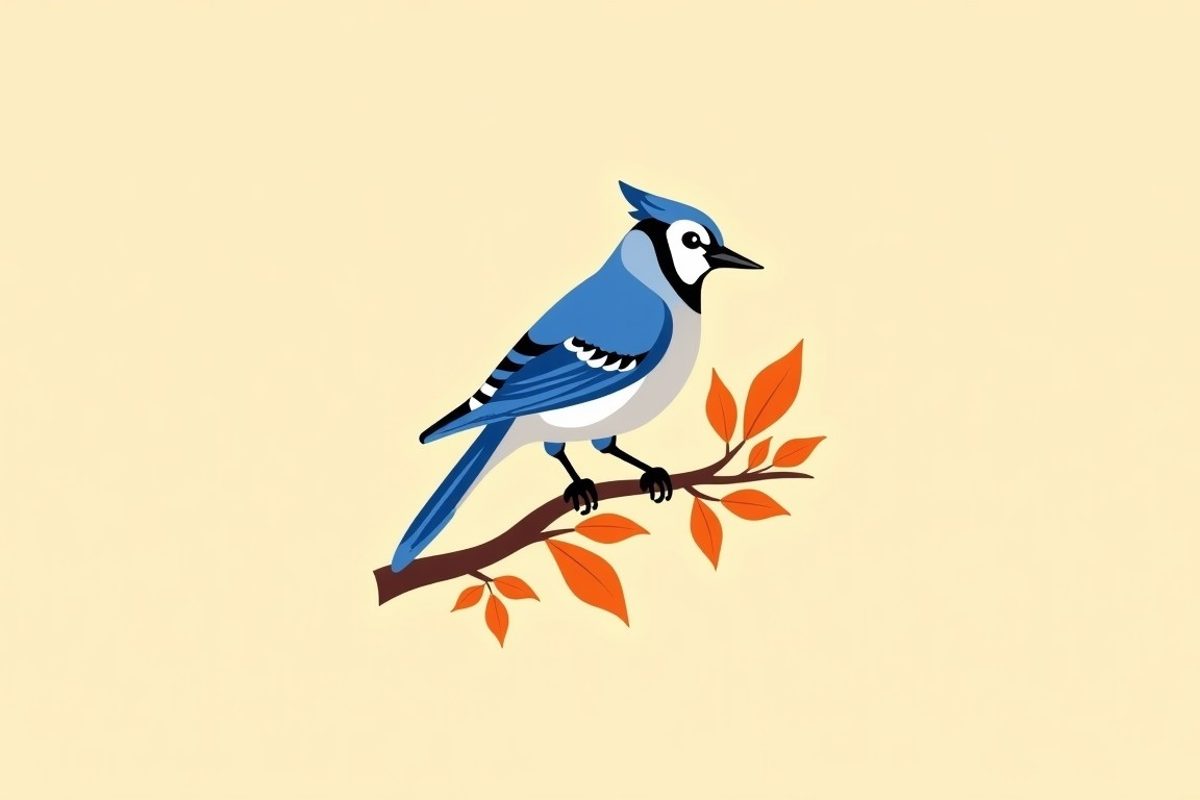
The blue jay spiritual meaning centers on courage, voice, and protection: a blue jay is usually read as a prompt to speak up with confidence, defend what matters to you, and use your intelligence instead of hiding it. Because the birds are loyal to their mates and fierce around their nests, many people also link them to devotion and to standing guard over family.
Blue jays are hard to ignore. They are bright, loud, and bold, and they often announce themselves before you see them. That presence is a large part of their symbolism. This guide explains what a blue jay generally means, what folklore actually says about it, how the bird is read in love and grief, what blue jay dreams may point to, and a practical way to respond when one shows up.
What Does a Blue Jay Mean Spiritually?
The blue jay (Cyanocitta cristata) is native to eastern and central North America. Much of its symbolism comes straight from its behavior:
- Confidence and boldness. Blue jays do not shrink from larger birds. They will chase hawks and owls away from their territory. Spiritually, this is read as a call to stand your ground.
- Communication and voice. Blue jays have a wide range of calls, and they can imitate the cries of red-shouldered and red-tailed hawks. Their symbolism often centers on speaking clearly and choosing your words with intent.
- Intelligence and planning. Blue jays cache acorns and other nuts to eat later. Ecologists such as W. Carl Johnson and Thompson Webb have argued that blue jays helped oak forests spread north after the last ice age by carrying and burying acorns. The bird is a symbol of foresight: planting now for a future you may not see.
- Loyalty and protection. Blue jays generally form long-term pair bonds and defend their nests aggressively. That makes them a sign of devotion and of guarding what you love.
- Clarity and truth. The vivid blue is often associated with honesty, the sky, and an open mind.
The surprising truth about blue jay feathers
Blue jay feathers are not actually blue in pigment. Their color comes from the microscopic structure of the feather, which scatters light so that it appears blue. If a feather is crushed or held with light behind it, it looks brownish-gray. Many people find a spiritual lesson in this: what you show the world depends on how light moves through you, and your true color appears when you are in the right conditions. If you have found one, see the spiritual meaning of feathers for more on feather signs. Note that in the United States, it is illegal to keep the feathers of most native wild birds, including blue jays, under the Migratory Bird Treaty Act, so it is best to admire and photograph them rather than collect them.
Blue Jays in Folklore and Tradition
Because blue jays live only in North America, they do not appear in the old myths of Europe or Asia. The folklore that does exist is specific and worth getting right.
Chinookan stories: Blue Jay the trickster
In the oral traditions of Chinookan peoples of the lower Columbia River, Blue Jay is a well-known trickster figure. In stories recorded in the late nineteenth century, Blue Jay is clever, boastful, and often reckless, and he appears with his sister Ioi, including in a story in which he visits the land of the dead. Because these communities live in the Pacific Northwest, the bird behind these stories is likely the Steller's jay rather than the eastern blue jay, but the character is usually translated simply as Blue Jay. In these tales the jay embodies intelligence that can tip into arrogance, a balanced lesson rather than a simple compliment.
Southern American folklore: the jaybird and Friday
In African American and wider Southern folklore in the United States, there is a well-documented belief that you will rarely see a jaybird on a Friday, because jays spend Fridays carrying sticks or grains of sand down to the devil. Folklorists and writers, including Joel Chandler Harris, recorded versions of this belief in the nineteenth century. It reflects the bird's reputation as a busy, slightly mischievous go-between, and it shows how blue jays were woven into everyday spiritual imagination long before modern sign-reading.
Modern spiritual interpretations
In contemporary spirituality, the blue jay is often connected with the throat chakra, the energy center associated with communication and self-expression in the chakra system. This is a modern interpretation rather than an ancient tradition, but it fits the bird's loud, expressive nature well. If you work with chakras, the blue jay can be a reminder to check whether you are expressing yourself honestly; the chakra balancing guide explains signs of a blocked throat chakra.
Blue jay vs. cardinal
Blue jays and cardinals are often seen at the same feeders, and people sometimes compare their meanings. The cardinal is most often read as a gentle sign of a loved one and of hope. The blue jay is louder and more assertive, pointing toward courage, communication, and protection. Seeing both together is sometimes taken as a balance of comfort and strength.
Blue Jay Spiritual Meaning in Love
Blue jays are a strong symbol in relationships because pairs work together closely. Both partners help build the nest, and the male feeds the female while she incubates the eggs. A blue jay appearing while you think about love might point to:
- Loyalty. Are you and your partner showing up for each other in practical ways, not just in words?
- Honest communication. The jay's message is to say what you mean. Unspoken resentment and mixed signals are not the jay's style.
- Protecting the relationship. Guarding your connection from outside pressure, such as overwork, interference, or old patterns, is part of the blue jay's lesson.
- Confidence in being seen. If you are single, a blue jay can encourage you to stop hiding and let people see who you are.
The trickster side of the jay is also worth considering. If you have been playing games, testing someone, or holding back to keep the upper hand, the jay may be pointing to that too.
Seeing a Blue Jay After Someone Dies
Many people report seeing blue jays after a loss, especially if the person loved birds or kept a feeder. A blue jay at that moment is often read differently from the softer cardinal or robin. It may feel like the person's personality coming through: lively, outspoken, protective, or funny.
Some people take a blue jay in grief as encouragement to keep living fully and to speak about the person openly rather than keeping grief silent. You do not need to decide whether it is a literal sign. You can simply let the moment remind you of the person and of the parts of them you want to carry forward. Keeping a short note of these moments, with the date and what you felt, can become a meaningful record over time.
Dreaming of a Blue Jay
As with any dream, your own feelings and associations matter most. Common blue jay dream images and how people often read them:
- A blue jay calling loudly: something needs to be said, or a part of you wants to be heard.
- A blue jay flying toward you: confidence or good news arriving, or a call to act.
- A blue jay attacking or chasing: someone in your life may be overly aggressive, or you may be defending yourself too forcefully.
- A blue jay hiding food: planning ahead, saving resources, or keeping something secret.
- A dead or injured blue jay: a voice that has been silenced, or a confidence that has been shaken.
- A pair of blue jays: partnership, loyalty, and teamwork.
Write the dream down quickly, including the emotion and any words you remember. Ask yourself where in waking life you feel unheard or overly loud.
The Blue Jay as a Spirit Animal
People who feel a strong connection to blue jays often describe themselves as expressive, curious, and protective. As an animal guide, the blue jay points toward:
- Using your voice. Speaking up in meetings, stating your needs, or sharing your ideas instead of waiting for permission.
- Resourcefulness. Making the most of what you have, planning ahead, and adapting to changing conditions.
- Fearlessness in defense. Standing up for people who rely on you.
- Curiosity. Blue jays explore, test, and investigate. They encourage learning across many subjects.
The challenge side of blue jay energy includes being too loud, too territorial, or using cleverness to manipulate. The trickster stories capture this well. A blue jay guide asks you to be bold without being a bully.
The term "spirit animal" comes from specific Indigenous practices, and many people use animal guide or totem symbol for personal reflection. The spirit animal guide covers this and offers ways to explore your connections. Blue jays also pair naturally with other birds: they mob hawks and share the bold intelligence of the crow, a fellow member of the corvid family.
What to Do When You See a Blue Jay
When a blue jay gets your attention, use it as a short check-in:
- Listen. Was the jay calling? What kind of call? A harsh alarm, a softer whistle, or even an imitation of a hawk? Notice your first reaction.
- Ask what you are not saying. Is there a conversation you have been putting off? A boundary you have not stated? An idea you have kept to yourself?
- Ask what you need to protect. Your time, your energy, a relationship, a project? The jay defends its nest without apology.
- Plant something for later. Like the jay burying acorns, take one small action today that your future self will thank you for.
- Write it down. Note the date, place, and what you were thinking about. Over weeks, patterns become clear.
A blue jay journal practice
For one week, answer these three questions each evening:
- Where did I hold back my voice today, and what would I have said?
- What or who did I protect today, and was it worth protecting?
- What small seed did I plant for a future I want?
You can also try a simple speaking practice inspired by the jay: once a day, say one thing clearly and kindly that you would normally have softened or left unsaid. Notice how people respond and how you feel afterward.
A Grounded Note on Blue Jay Signs
In much of eastern North America, blue jays are common backyard birds, especially around oak trees and feeders. Seeing one is not rare, and its appearance does not predict a particular event. What makes a moment meaningful is the timing and your own response: the jay that calls as you hesitate before a hard conversation, or the one that lands nearby just as you think of someone you have lost. Treat those moments as prompts to act with courage and clarity. The jay's message is simple: be honest, be brave, and protect what you love.
Frequently Asked Questions
What does it mean when you see a blue jay?
Seeing a blue jay is usually read as a prompt to speak up, act with confidence, and protect what matters to you. The bird is bold, vocal, and fiercely protective of its nest, so its symbolism centers on courage and clear communication. Notice what you were thinking about when it appeared.
Is a blue jay a sign from a loved one?
Many people feel a blue jay appearing after a loss is a reminder of the person, especially if they were lively or outspoken. You can treat the moment as a chance to remember and honor them without needing to prove it is a literal message. Keeping a note of such moments can be comforting.
Is seeing a blue jay good luck?
Blue jays are generally seen as a positive sign of confidence, loyalty, and resourcefulness. Some Southern American folklore gives them a mischievous reputation, but there is no widely held belief that they bring bad luck. They are best read as encouragement rather than a prediction.
What does a blue jay mean in love?
In love, the blue jay points to loyalty, teamwork, and honest communication, because pairs generally form long-term bonds and raise their young together. It can also encourage single people to be more open and visible. The trickster side of the jay can be a warning against playing games.
What is the difference between a blue jay and a cardinal as a sign?
The cardinal is most often read as a gentle sign of hope and a loved one nearby. The blue jay is louder and more assertive, pointing to courage, speaking up, and protecting your territory. Seeing both together is sometimes interpreted as a balance of comfort and strength.
What does it mean to dream about a blue jay?
A blue jay in a dream often relates to your voice, confidence, or need to protect something. A loud jay may mean something needs to be said, while a jay hiding food can point to planning or secrets. The emotion you felt in the dream is the best guide to its meaning.