The spiritual meaning of spiders centers on creativity, patience, and fate: a spider is read as a reminder that you are weaving your own life thread by thread, and that steady, careful work builds something both delicate and strong. In many traditions spiders are also storytellers, grandmothers, and protectors, which makes them far more positive symbols than their spooky reputation suggests.
Most people react to spiders before they think about them. Yet across the world, the spider has been honored as a creator, a teacher of weaving, a keeper of stories, and even a guardian of a prophet. This guide covers what spiders generally symbolize, what specific cultures say about them, what a spider might mean in love and grief, how to read spider dreams, and a practical way to work with the spider's message.
What Do Spiders Mean Spiritually?
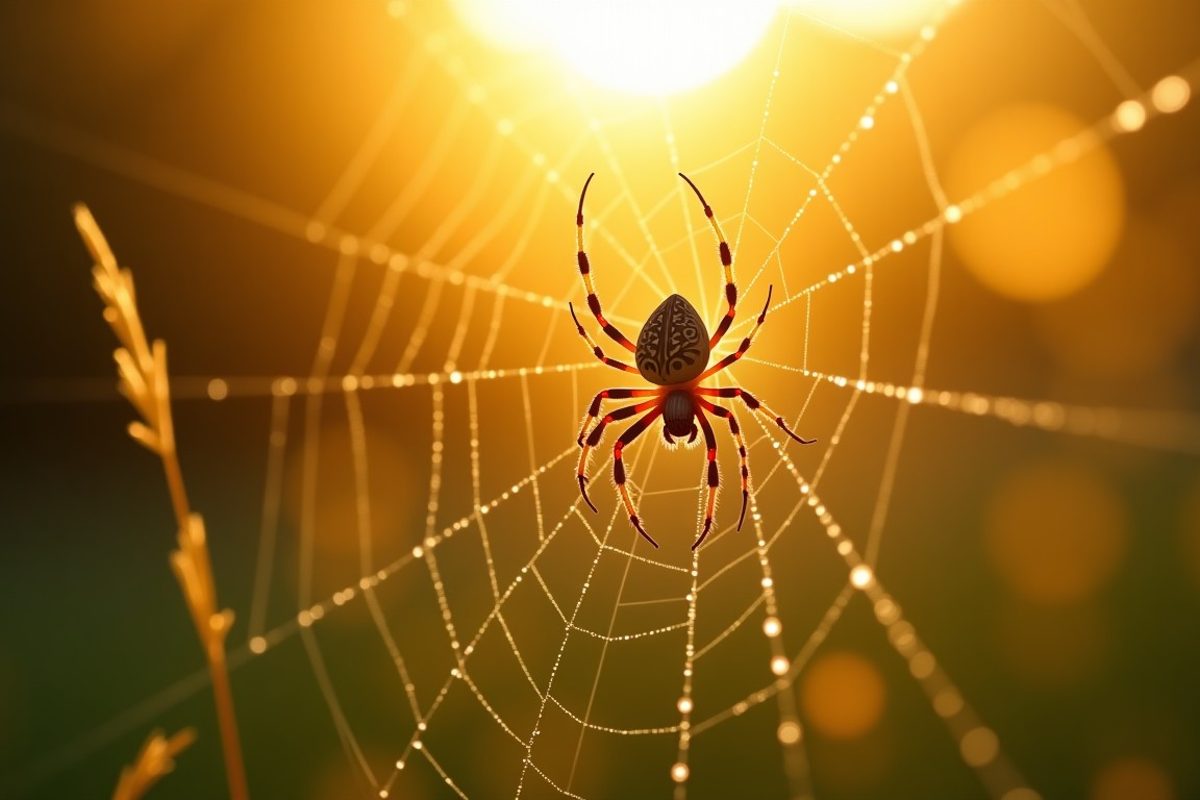
Spider symbolism draws heavily on the web. A web is a structure built from the spider's own body, designed with precision, and often rebuilt after it is damaged. Many orb-weaving spiders take down and rebuild their webs regularly, sometimes daily, and some eat the old silk to recycle its protein. From these facts come the main themes:
- Creativity. The spider makes something intricate out of itself. It is a classic symbol for writers, artists, and anyone building from their own resources.
- Patience. A spider builds, then waits. It does not chase. Spiritually, this points to trusting the work you have done and letting results come to you.
- Fate and interconnection. Many cultures link spinning and weaving with destiny. The web is also an image of how everything is connected: touch one strand and the whole web moves.
- Resilience. A broken web is rebuilt. The spider teaches recovering from setbacks without drama.
- Feminine creative power. In several traditions, the spider is a grandmother or woman who creates, teaches, and protects.
It is also worth acknowledging fear. Arachnophobia is among the most common specific phobias. If spiders frighten you, their appearance may have a different message: something you are avoiding, or a fear that is smaller than it feels.
Spiders in Cultural and Religious Traditions
Here is what specific traditions say, rather than a blended "ancient wisdom" version.
West Africa: Anansi, owner of all stories
Among the Akan people of Ghana, Anansi the spider is the great trickster and storyteller. In the best-known tale, all the world's stories belong to Nyame, the sky god. Anansi asks to buy them, and Nyame names a price that seems impossible: Anansi must capture Onini the python, Osebo the leopard, the Mmoboro hornets, and the fairy Mmoatia. Using wit rather than strength, Anansi captures them all, and Nyame gives him the stories, which is why many Akan tales are called Anansesem, "spider stories." Through the Atlantic slave trade, Anansi stories traveled to the Caribbean and the Americas, where versions such as "Anancy" in Jamaica remain popular. Here the spider stands for intelligence, storytelling, and the power of the small to outwit the strong.
Hopi and Diné (Navajo): Spider Grandmother and Spider Woman
In Hopi tradition, Spider Grandmother (Kokyangwuti) is a creator figure who helps bring people into being and guides them through their emergence into this world. In Diné (Navajo) tradition, Spider Woman (Na'ashjé'ii Asdzáá) taught the Diné people how to weave, and Spider Rock in Canyon de Chelly is associated with her. These are distinct traditions with their own teachings, but in both, the spider is a wise, protective grandmother figure and a source of creative skill.
Cherokee: Water Spider brings fire
In the Cherokee story often called "The First Fire," the world is cold after lightning sets fire to a hollow tree on an island. Several animals try to bring the fire back and fail. Finally the small Water Spider weaves a bowl, carries it across the water on her back, and returns with a coal of fire for everyone. The spider is the humble one who succeeds where the strong fail, through skill and resourcefulness.
Ojibwe: Asibikaashi and the dreamcatcher
The dreamcatcher comes from the Ojibwe (Anishinaabe) people, and its traditional name, asabikeshiinh, is related to the Ojibwe word for spider. Ojibwe stories tell of Spider Woman (Asibikaashi), who cared for the people and especially for children. As the people spread out and she could not reach every cradle, dreamcatchers woven like her web were hung to protect children's sleep. The modern mass-produced dreamcatcher is a long way from this origin, which is worth remembering.
Greek myth: Arachne
In Ovid's Metamorphoses, Arachne is a gifted mortal weaver who boasts that her skill rivals Athena's. In the contest that follows, Arachne weaves a flawless cloth showing the gods' misdeeds. Athena, enraged, destroys it, and Arachne is transformed into a spider so she can weave forever. Our word "arachnid" comes from her name. The story carries layered meanings: extraordinary talent, the danger of pride, and the price of telling uncomfortable truths.
Islam: the spider of the cave
The 29th chapter of the Qur'an is named Al-Ankabut, "The Spider." Its verse 41 compares those who rely on protectors other than God to a spider that builds a house, noting that the frailest of houses is the spider's. Islamic tradition also tells that when the Prophet Muhammad and Abu Bakr hid in the Cave of Thawr during the migration from Mecca to Medina, a spider spun a web across the entrance, and their pursuers, seeing the unbroken web, assumed no one was inside. The spider here is a small instrument of divine protection.
Scotland and England: perseverance and luck
A famous legend says that Robert the Bruce, hiding after a defeat, watched a spider try again and again to swing its thread to a beam until it succeeded, and took heart to keep fighting. The story was popularized by Sir Walter Scott in the nineteenth century and may not be historical, but it made the spider a symbol of perseverance. In English folk belief, killing a spider is unlucky, as captured in the old rhyme "If you wish to live and thrive, let a spider run alive." Tiny "money spiders" landing on you are said to bring money your way.
Japan: the jorogumo
Japanese folklore offers a darker spider image. The jorogumo is a yokai, a supernatural creature, said to be a spider that can take the form of a beautiful woman and lure people into danger. It is a reminder that in some cultures the spider also stands for entrapment and deception.
Spiritual Meaning of Spiders in Love
A spider appearing while you think about love can point to a few different things:
- Building patiently. Strong relationships, like webs, are made strand by strand. Small daily actions matter more than dramatic gestures.
- Interconnection. A spider can remind you that your relationship sits within a wider web of family, friends, and history. Problems in one area affect the rest.
- Feeling trapped. On the other side, a web can be a trap. If you feel tangled or stuck in a relationship, the spider may be reflecting that.
- Creative intimacy. The spider can encourage you to bring more creativity and play into the connection.
Ask which description fits. Is your relationship a web you are weaving together, or one you are caught in?
Spiders and Grief
Because the spider is linked with weaving and fate, it can be a gentle symbol in grief. Some people take a spider in their home after a death as a sign of the person's continued presence, especially in cultures where spiders are considered lucky guests. More broadly, the web is a picture of how a life is woven into others. When someone dies, the web is changed, but their threads remain part of it. If a spider catches your attention while you are grieving, you might let it remind you of the ways the person is still woven into your life, through memories, habits, and the people you share.
Dreaming of Spiders
Your feelings about spiders shape their meaning in dreams. Common scenarios and how people often interpret them:
- A spider weaving a web: creative work in progress, or a plan coming together.
- Being caught in a web: feeling trapped by a situation, relationship, or obligation.
- A spider crawling on you: a worry that feels too close, or something you need to notice.
- Being bitten by a spider: a hurtful remark, betrayal, or a sharp wake-up call.
- A giant spider: a fear that has grown out of proportion. Sometimes interpreted as a powerful figure in your life.
- Killing a spider: overcoming a fear, or, in some readings, cutting off your own creativity.
- Many spiders: scattered worries or many small projects competing for your attention.
Write the dream down quickly, along with the emotion. For more on interpreting dream symbols, see the language of dreams.
The Spider as a Spirit Animal
People who feel a strong pull toward spiders are often makers: writers, designers, planners, and builders. As an animal guide, the spider represents:
- Creative discipline. Inspiration matters, but the web is built by steady work.
- Strategy. Spiders place their webs carefully, where opportunity will come to them.
- Patience. Trusting that what you have built will bring results in time.
- Resilience. Rebuilding after a setback without giving up.
- Awareness of connection. Feeling the vibrations of what happens around you and understanding how one change ripples out.
The shadow side of spider energy includes manipulation, isolation, and getting caught in your own overthinking, a web of thoughts that traps rather than supports you. The term "spirit animal" comes from specific Indigenous practices; many people use animal guide or totem symbol for their own reflection. The spirit animal guide explains how to explore your connections respectfully.
The spider pairs naturally with other symbols of change. The snake sheds an old skin, the frog transforms from water to land, and the dragonfly emerges into light. The spider adds the quiet work of building what comes next.
What to Do When You See a Spider
A spider in your home or path can be an invitation to a short reflection:
- Pause before reacting. Notice your first response: fear, irritation, curiosity. That response says something about how you meet the unexpected.
- Notice the details. Was the spider building a web, resting, or moving? Where was it? In a corner, near a window, on your desk?
- Ask what you are weaving. What project, relationship, or plan are you building right now? Is it getting your steady attention?
- Ask where you feel caught. Is there a situation you feel tangled in? What single strand could you cut or loosen?
- Write it down. Date, place, what you noticed, and your reflections.
If you want the spider out of your home, a cup and a piece of card let you carry it outside gently, which also honors the old folk advice to let spiders live.
A web journaling practice
Draw a simple web on a page: a dot in the center and six or eight lines out from it. Write your name in the center. On each line, write one area of your life: work, health, family, friends, creativity, spirituality, money, rest. Then, along each line, note one small action that would strengthen that thread this week. Return to the page in seven days and notice which threads you strengthened and which you neglected. For more structured prompts, try these journaling prompts for self-discovery.
A Grounded Note on Spider Signs
Spiders are everywhere, and many people share their homes with dozens of them without noticing. Seeing one is not rare and does not predict good or bad fortune. What makes a moment meaningful is timing and attention: the web you notice glistening in morning light just as you are about to give up on a project, or the spider that appears again and again on your desk. Treat those moments as prompts to look at what you are building. The spider's message, in nearly every tradition that honors it, is that patient, careful work creates something that can hold, and that you are both the weaver and part of a larger web.
Frequently Asked Questions
What does it mean when you see a spider?
A spider is usually read as a sign of creativity, patience, and building your own path step by step. It can also be a reminder that you are connected to others like strands in a web. If spiders frighten you, the sighting may instead point to a fear you have been avoiding.
Is it bad luck to kill a spider?
In English folklore, killing a spider is considered unlucky, as in the old rhyme about letting a spider run alive. Many cultures see spiders as protective or lucky house guests. If you want one out of your home, you can gently carry it outside instead.
What does a spider mean in love?
In love, a spider can symbolize building a relationship patiently through small, consistent actions. It can also reflect feeling trapped or tangled if a relationship has become restrictive. Ask whether you feel like a co-weaver of the relationship or caught in its web.
What does it mean to dream about spiders?
Spider dreams often relate to creativity, feeling trapped, or fears that have grown out of proportion. A spider weaving can mean a plan coming together, while being caught in a web suggests feeling stuck. The emotion you felt in the dream is the best clue.
Who is Anansi the spider?
Anansi is a spider trickster and storyteller from the folklore of the Akan people of Ghana. In a famous tale, he wins all the world's stories from the sky god Nyame by outwitting powerful creatures. His stories traveled to the Caribbean and Americas, where versions remain popular.
What does a spider in the house mean spiritually?
A spider in the house is often seen as a sign of protection or good fortune, especially in English folk belief. Spiritually, it can prompt you to look at what you are building at home and in your life. A spider in your workspace may point to creative projects in particular.